Breadcrumb

white paper -html

White Paper on Base MHIT Plan

The base medical and health insurance/takaful (MHIT) plan is a key component of the RESET strategy, a collaborative effort by the Ministry of Finance, Ministry of Health, Bank Negara Malaysia and key stakeholders to address medical inflation and strengthen Malaysia's healthcare system.

The White Paper outlines the details on the base MHIT plan, drawing on feedback and input from over 60 engagements with key stakeholders, consumer focus groups and extensive analyses of available datasets to ensure the product is aligned with reform goals and market needs.

Executive Summary

Medical health insurance/takaful (MHIT) plays an important role in financing private healthcare, however its contribution to private healthcare funding remains low. Higher costs associated with access to private healthcare can also limit choices for the public and increase inequities in service delivery and health outcomes. Premium[1] increases in recent years have further increased affordability challenges for access to private healthcare. In response, the Ministry of Health (MOH), the Ministry of Finance (MOF) and Bank Negara Malaysia (BNM), introduced the RESET Strategy outlining a coordinated set of focused initiatives to address private healthcare costs.

A central initiative under this strategy is the development of a standardised base MHIT plan. This plan aims to expand financial protection for essential healthcare needs, channel private spending more efficiently and strengthen conditions for broader health system reforms in line with value‑based care that improves health outcomes with disciplined cost management.

The base MHIT plan is designed to deliver affordable, meaningful and sustainable protection through:

  • Targeted coverage for individuals who are currently uninsured or seeking an affordable alternative to existing MHIT products;
  • Standardised benefits to provide meaningful protection for common and high‑impact medical episodes based on medical claims trends;
  • An alternative, lower premium option of the base plan that provides a higher annual coverage limit with higher deductibles for those who prefer protection mainly against catastrophic expenditures and can afford higher upfront costs in the event of a hospitalisation episode;
  • More equitable risk rating approaches along with broader risk pooling mechanisms to smoothen overall claims experience and premium adjustments;
  • A differentiated co‑payment structure to encourage cost‑effective provider selection, preserving choice while recognising hospitals committed to quality, transparency, and value‑based care; and
  • Access to optional preventive and wellness services, offered at negotiated rates to support healthier outcomes.

The base plan will be offered as a standalone medical protection plan and will not be linked to investment products. It will co-exist with MHIT products offered competitively by individual insurers and takaful operators, serving as a baseline for broader reforms to existing market offerings to reduce unwarranted price escalation, support more consistent care standards and ensure better alignment between providers, payers and patient outcomes. Such reforms include strengthened cost containment measures, enhanced transparency and a phased transition from a fee‑for‑service payment system to payments based on Diagnosis-Related Groups (DRGs).

A pilot implementation of the base MHIT plan is expected in the second half of 2026, ahead of its introduction in the market in early 2027. This marks a major step towards building a more financially sustainable, equitable and value‑driven private healthcare ecosystem that supports Malaysia’s long‑term health system goals.
Background

Private healthcare services have grown rapidly in the past decade to complement the public healthcare system mainly serving higher-income populations in urban centres, with approximately 56% of private healthcare beds concentrated in these areas. This has been primarily funded through out-of-pocket (OOP) healthcare spending by households. Based on Malaysia’s National Health Accounts[2], 49% of total expenditure on healthcare (TEH) in 2024 was financed from private sources, mainly to pay for services and supplies provided by private hospitals (23%) and ambulatory health care providers including private clinics (14%). At 39% of TEH, household OOP spending has continued to overwhelm private insurance funding for healthcare which represented less than 8% of TEH. 

The relatively high share of household OOP funding for healthcare poses concerns over the financial protection of households who may not be adequately protected against catastrophic medical expenditures. Higher costs associated with access to private healthcare can also limit choices for the public and increase inequities in service delivery and health outcomes. People who can no longer afford private healthcare or insurance end up falling back to public healthcare services, creating a vicious loop in which private healthcare spending continues to rise without sustainably improving equitable access to care. Furthermore, poor integration between the public and private healthcare systems results in unnecessary duplication of care.

There are various reasons for rising private healthcare expenditures. They include higher disease burdens, medical technology advancements and high costs of hospital supplies and services. Some aspects of current MHIT product designs have also contributed to higher utilisation and costs of private healthcare services. In particular, existing fee-for-service payment models, and unhealthy competition driving excessive policy limits, low co-payments and complex product structures provide little incentive for providers to evolve more efficient healthcare models. Similarly, patients are not empowered to make prudent financial and healthcare choices.

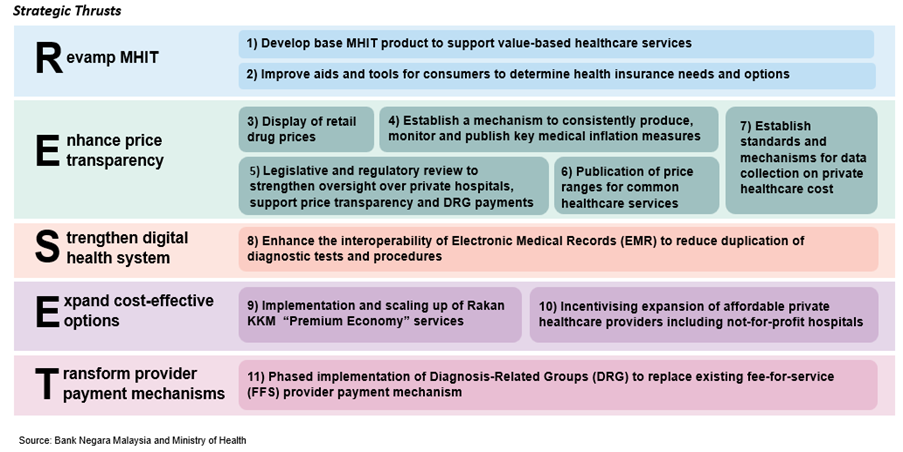
Between 2021 and 2024, actions by insurers and takaful operators to resume regular premium adjustments that had been paused during the COVID years triggered a renewed spotlight on private healthcare costs. In response to significant premium adjustments that reflected a persistent increase in overall medical claims costs, interim measures were introduced by BNM in December 2024 to support existing policyholders. This was swiftly followed by the announcement in March 2025 of specific initiatives under the RESET Strategy (Diagram 1), formulated collaboratively by MOH, MOF and BNM, to address private healthcare costs.

Diagram 1: Five Strategic Thrusts and Eleven Initiatives to Address Medical Inflation

Revamp MHIT 1) Develop base MHIT product to support value-based healthcare services
2) Improve aids and tools for consumers to determine health insurance needs and options
Enhance price transparency 3) Display of retail drug prices 4) Establish a mechanism to consistently produce, monitor and publish key medical inflation measures 5) Establish standards and mechanisms for data collection on private healthcare cost
6) Legislative and regulatory review to strengthen oversight over private hospitals, support price transparency and DRG payments 7) Publication of price ranges for common healthcare services
Strengthen digital health system 8) Enhance the interoperability of Electronic Medical Records (EMR) to reduce duplication of diagnostic tests and procedures
Expand cost-effective options 9) Implementation and scaling up of Rakan KKM "Premium Economy" services 10) Incentivising expansion of affordable private healthcare providers including not-for-profit hospitals
Transform provider payment mechanisms 11) Phased implementation of Diagnosis-Related Groups (DRG) to replace existing fee-for-service (FFS) provider payment mechanism

Source: Bank Negara Malaysia and Ministry of Health

The RESET Strategy reflects a commitment to a “whole-of-nation” response required to deal with the multi-faceted issues involved to deliver better health outcomes for all Malaysians. Initiatives under the RESET Strategy are not exhaustive. They are intended to guide near term priorities that will serve to strengthen current healthcare settings and provide stronger foundations for longer-term health reform pillars and strategies outlined in the Health White Paper for Malaysia[3].

A key component of the RESET Strategy is the development of a base MHIT plan that aims to transform private health insurance offerings in the market. This White Paper sets out further details on the base MHIT plan, including its key design considerations to support ongoing and future health system reforms.

The Paper is organised as follows:

  • A. Policy objectives and key design considerations
  • B. About the base MHIT plan
  • C. Design features of the base MHIT plan that improve on current private health insurance settings

The White Paper has been informed by over 60 multi-stakeholder engagements[4] conducted over several months since the announcement of the interim measures, as well as analyses of significant volumes of available datasets. Public focus groups and field-tests of key product features were also carried out in September and November 2025. The valuable inputs received from these engagements and touchpoints are gratefully acknowledged. Work is currently underway to prepare policies, systems and processes for a product pilot in the second half of 2026 and eventual launch of the base MHIT plan in early 2027.

A. Public policy objectives and key design considerations

The base MHIT plan is conceived with the support of MOH, MOF and BNM to achieve the following public policy objectives:

  • enable more Malaysians to obtain a base level of financial protection against essential, high-impact healthcare expenditures through a voluntary standardised insurance and takaful plan that is affordable, sustainable, meaningful and easy to understand;
  • channel private healthcare spending more efficiently to better complement universal access to public healthcare services[5]; and
  • accelerate progress towards value-based healthcare by leveraging strategic purchasing and creating structural conditions that promote consistent standards of high quality care and disciplined cost management.

Guided by these policy objectives, the key design considerations for the base MHIT plan are focused on the following questions:

  • what are the target segments for the base MHIT plan, considering the trade-offs between affordability and inclusivity?
  • what benefits should the base MHIT plan cover for a given level of premium that would be considered affordable for the target segments?
  • what are the key cost containment strategies needed to ensure that premiums will remain affordable in line with improvements towards value-based care models?
  • what are the opportunities that can be leveraged through the base MHIT plan to provide greater transparency to patients, payers and providers?
  • how would premiums be set to ensure sustainability while improving equity?
  • what are the minimum standards that ITOs must meet to support the long-term sustainability of the base MHIT plan and realise broader market reforms for private MHIT offerings?
  • how can the base MHIT plan play a role in shaping more sustainable and seamless choices for consumers based on their individual needs and financial circumstances?

The following sections of the Paper elaborate the proposed direction taken for the base MHIT plan, reflecting a careful consideration of these questions.

B. About the base MHIT plan

Target segments

The base MHIT plan offers a foundational MHIT plan that is focused on two key target segments:

  • The first target segment is individuals who do not currently have insurance/takaful protection for major healthcare expenditures but who are able to sustainably afford private healthcare coverage. Currently, about 22% of the population in Malaysia[6] are covered by individual MHIT plans, placing Malaysia at the lower end of the spectrum among countries with reasonably developed private health insurance systems[7]. This also explains the relatively low share of private insurance funding for healthcare compared to household OOP. Further, existing policyholders tend to be more concentrated in higher income segments of the population due to affordability challenges. Business strategies of larger ITOs may also target the more affluent market segments. There is therefore a greater need to strengthen financial protection for middle income households who may be willing and able to purchase a more affordable insurance and takaful plan; 
  • The second target segment is individuals who are seeking more affordable alternative options to their existing MHIT plans due to significant premium increases over time, especially at older ages. Prior to the implementation of interim measures in 2025 to temporarily cap premium increases by ITOs, rising medical claims inflation had seen premiums for the majority of policyholders being revised upwards by up to 40% to reflect higher claims costs (Table 1). Between January 2024 to June 2025, ITOs reported around 340,000[8] MHIT policies (representing 5.2% of policies repriced) that were surrendered by policyholders following regular repricing exercises to reflect medical inflation. Such policyholders currently lack viable alternative plans that they can switch to in order to maintain their protection.

Table 1: Distribution of premium increase under repricing exercises by ITOs in 2024

Range of premium increases <10% 11%-20% 21-40% 41-60% >60%
% of revised policies 21% 40% 30% 5% 4%

The base MHIT plan will provide protection for individuals up to 85 years of age. The maximum age for enrolment into the plan is 70 years old.

Affordability is a key consideration in the design of the base MHIT plan to achieve premium levels that would be within reasonable affordability thresholds of the target market segments. This will involve necessary trade-offs between rationalising coverage and prioritising more cost-effective healthcare delivery models (elaborated further in the following sections). 

Standardised benefits

The base MHIT plan provides a standardised package of benefits that mainly help to pay for healthcare services received at private hospitals. This includes costs associated with:

  • hospital room and board
  • hospital supplies and services
  • surgical fees
  • anaesthetist fees
  • in-hospital physician visits
  • medications associated with a treatment episode
  • selected high-cost outpatient medications for serious illnesses (e.g. cancer) that are listed by MOH
  • ambulance fees
  • intensive care
  • operating theatre fees
  • day surgeries
  • immediate pre- and post-hospitalisation services, including costs of consultation, diagnostics tests and medications

As private hospitals include a wide spectrum of lower-, mid- and higher-tier facilities offering different levels of service, the coverage limit under the base MHIT plan is set in reference to benchmark costs for lower and mid-tier private hospitals. This serves to keep premium levels within the reach of more individuals. An individual who seeks treatment at a higher-tier hospital will still be covered under the base MHIT plan, but the applicable annual limit and higher co-payments will mean that a smaller share of the hospital bill will be paid by the plan. 

Individuals requiring additional coverage beyond what is provided under the base MHIT plan will be able to choose from a range of different medical and takaful plans offered by ITOs. Such plans must minimally provide the benefits of the base MHIT plan along with meaningful additional benefits that may include higher limits of coverage or treatment options that are not included under the base MHIT plan. As these plans will vary between ITOs, individuals will need to shop around for plans that best suit their needs and financial circumstances.

Annual limits commensurate with reasonable protection for most common conditions

To ensure that the base MHIT plan can be sustained at affordable premiums while offering meaningful protection against potential healthcare expenditures, the annual policy limits are calibrated to cover high-volume procedures and common complex admissions in private hospitals. It is expected that highly complex and costly treatments that are likely to exceed the policy limits will continue to be managed within the public healthcare system as the base MHIT plan is complementary to, and not a replacement of, the public healthcare system. Guided by these considerations, the annual policy limit is set at RM100,000. This limit is supported by recent medical claims distributions and trends (Table 2), which suggest that the limit would be adequate to cover 99% of treatment episodes across a range of common medical conditions, even after allowing for some possibility of multiple admissions.

Table 2: Medical claims distribution based on Insurance Services Malaysia (ISM) data in 2024

Percentile 25th 50th
(Median)
75th 90th 95th 99th
Year 2024: Cost of individual claims paid (in RM) 3,393 5,695 10,069 20,412 29,744 55,225

Recognising that older individuals may be more likely to present with multiple and more complex medical conditions which can lead to higher treatment costs, the annual policy limit automatically adjusts upwards to RM150,000 for individuals aged above 60 years. This will provide an additional level of protection that ensures the annual limit remains relevant over a person’s lifetime. 

Standard-plus plan offered as a lower cost option

Individuals will also have the option of buying a standard-plus base MHIT plan that provides a higher amount of coverage with an annual policy limit of RM300,000, at considerably lower premiums. Under this plan, individuals will bear the costs of hospital bills up to the deductible amount in the event of a hospitalisation episode, and the plan will pay for any costs above that amount. For the standard-plus plan, the deductible levels of between RM10,000 and RM15,000, are being considered, in line with comparable products in the market.

Such a plan caters to individuals who may already be covered under medical benefit plans provided by their employers, or who have the ability to bear a larger share of payments for hospital bills and only wish to protect themselves against catastrophic expenditures. Premiums for the standard-plus plan are expected to be between 15% and 70% lower across different age bands due to lower overall claims that will be borne by the insurance/takaful pool.

Greater premium stability

Premiums and contributions for the base MHIT plan will be set by authorities based on sound actuarial principles and with reference to a target loss ratio with reasonable margins to meet expenses. Premiums will be risk-rated, factoring in an individual’s age, gender and health status to ensure the sustainability of the risk pool to meet claims.

The adoption of risk-rating considers the well-documented challenges associated with community rating[9] under voluntary health systems observed in other countries. While full community rating can improve equity through the cross-subsidisation of higher-risk lives, it can lead to substantially higher premiums borne by healthy lives. Under a voluntary system, this increases adverse selection where healthier lives delay or refrain from buying insurance/takaful until they are sick, causing the overall experience of the pool to deteriorate and eventually become unaffordable and unsustainable. 

Nevertheless, the following rating approaches will be adopted to improve equity and fairness:

  • applying a reasonable ratio of premiums charged between older and younger lives, thereby “flattening” the risk curve;
  • broader risk pooling across all participating ITOs with risk equalisation arrangements which helps to reduce claims volatility of the pool and supports more stable premiums for the base MHIT plan over time; and
  • applying limits on individual loading based on health status.

These approaches help to better distribute financial risks across the system in order to ensure that more vulnerable segments will continue to have fair and affordable access to coverage.

The target premium range for the base MHIT plan takes into account inputs from consumer focus groups conducted and assessments of household disposal incomes to strike an appropriate balance between considerations of affordability and meaningful coverage. Achieving this balance crucially depends on disciplined cost containment strategies that include the use of co-payments, the progressive move towards DRG-based payments and better use of data analytics to inform product settings, claims management and the procurement of healthcare services. An indication of the affordable premium range for the base MHIT plan is provided in Table 3. This will serve to guide the final premiums for the base MHIT plan which will be announced closer to its launch in 2027.

Table 3: Indicative target premium range [10]

31-35 years
Standard plan
RM80 - RM120
Standard-plus plan
RM50 - RM70
61-65 years
Standard plan
RM280 - RM350
Standard-plus plan
RM220 - RM280
Above 75 years
Standard plan
RM500 - RM780
Standard-plus plan
RM400 - RM660

Premiums for the base MHIT plan will be subject to periodic review by authorities to ensure the premium levels remain sufficient to pay claims. The revision to the premium levels will take into account the claims experience of the risk pool, medical inflation as well as any revision to the benefits covered.

Differentiated co-payments

Co-payments (in the form of deductibles or a percentage of the cost of treatment borne directly by individuals) are a key feature of the base MHIT plan to control unnecessary utilisation of expensive and less efficient healthcare services which increases the overall costs of providing insurance. Such costs ultimately have to be paid for through higher premiums that are charged to all policyholders.

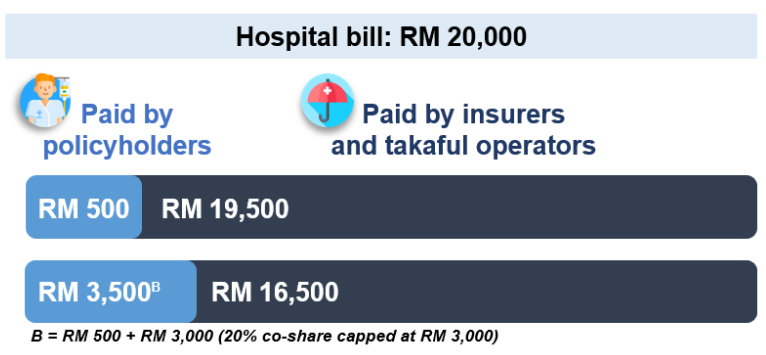
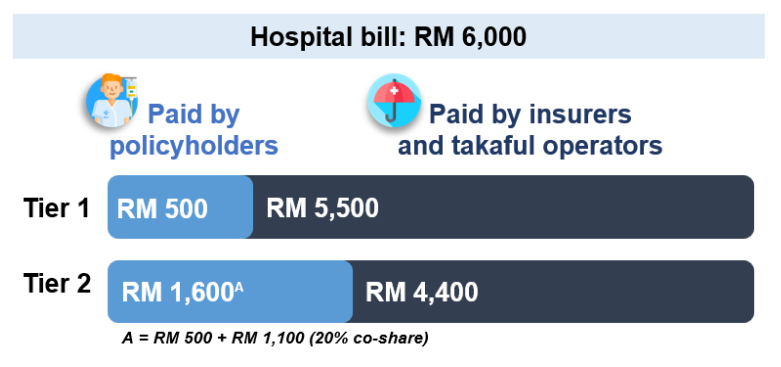
The base MHIT plan will apply a two-tier co-payment structure (Diagram 2) differentiated by healthcare providers which is designed to encourage individuals to optimise their healthcare choices and promote sustainability of the risk pool:

  • 1. Tier 1 (“In-network” hospitals):
    • 1.1 Deductible: RM500 deductible per disability[11], increased to RM1,000 at age 61 in tandem with higher annual limit
    • 1.2 Co-share: Zero.

  • 2. Tier 2 (”Out-of-network” hospitals):
    • 2.1 Deductible: RM500 deductible per disability[11], increased to RM1,000 at age 61 in tandem with higher annual limit
    • 2.2 Co-share: 20% capped at RM 3,000 per disability[11].

In-network hospitals are hospitals that demonstrate an appropriate use of resources aligned to best-practice, cost-efficient care models, and are committed to minimum standards of cost transparency and service levels. The selection of hospitals within the network will also consider factors to ensure adequate access (in terms of location and capacity[12]) for individuals covered under the base MHIT plan. 

Diagram 2: Example of Two‑Tier Co‑Payment Structure

Access to optional wellness and preventive care packages

In line with efforts to encourage a greater focus on prevention to reduce direct and indirect healthcare costs, wellness and preventive care services will be offered to individuals covered under the base MHIT plan as an optional purchase at discounted rates. Individuals can avail of these additional benefits at their own cost for selected vaccinations, general health screening services and other wellness packages designed to encourage early detection, promote healthier lifestyles, and support proactive management of one’s health. This approach ensures that individuals can benefit from preventive care without increasing premiums for all members, while promoting better health outcomes that can reduce long-term healthcare costs and support premium sustainability for the base MHIT plan. 

The services included within the optional care package were developed from an evidence- and value-based assessment undertaken in line with a Health Technology Assessment (HTA)[13] by MOH. A similar process leveraging on HTAs will be observed for any future expansion of the services offered. Over time, as clarity on reduced direct healthcare expenditures is established, coverage under the base plan may be reviewed to include relevant preventive services within the benefits package.

Not an investment-linked product

The base MHIT plan will be offered as a standalone medical protection plan, and will not be linked to investment products. Currently, more than 70% of MHIT plans are sold as riders to investment-linked products where an individual’s MHIT coverage may be affected by the performance of the policyholders’ investment accounts, as well as their decisions to withdraw and/or top up monies from/into their accounts. While investment-linked products can provide greater financial management flexibility to policyholders, they are not well understood by most policyholders despite measures taken to improve disclosures that should help consumers make wise financial choices. This has increased concerns over individuals who may unwittingly find themselves with inadequate financial protection.

Not social insurance

The base MHIT plan is not a social insurance scheme. It is a national initiative, however, participation is voluntary. Premiums for the base MHIT plan will be borne by individuals from their own savings or income. EPF contributors will have the option to pay for premiums from savings in their EPF Account Sejahtera which is already currently designated for medical, education and housing expenses[14]. This is entirely at the discretion of contributors with no compulsion to draw on EPF savings. To help individuals plan their finances, aids and tools will be developed to guide individuals on the amount they should be setting aside for medical expenditures, including amounts to meet reasonable future premium increases over their lifetime.

C. Design features of the base MHIT plan that improve on current private health insurance/takaful settings

The base MHIT plan improves on current private health insurance/takaful settings in several important ways to deliver protection that is fair, more equitable, transparent, sustainable, and aligned with better care pathways.

Raising the bar in the offering of MHIT plans

The base MHIT plan is designed to co-exist with individual MHIT products that are offered by ITOs in the market under the following conditions:

  • participating ITOs[15] must demonstrate the ability to meet qualifying criteria in order to offer the base MHIT plan; and
  • an ITO that wishes to offer its own MHIT products must also offer the base MHIT plan on a standalone basis alongside its own MHIT products.

These conditions aim to promote more consistent standards and approaches in aspects of MHIT underwriting, sales and claims practices across ITOs, with the base MHIT plan serving as a baseline for benefits design and pricing of other MHIT products. Additional regulations and guidelines applicable to MHIT products offered competitively by ITOs will also be introduced by BNM to bring market offerings in line with key principles adopted for the base plan, reduce opportunities for arbitrage and mitigate adverse migration risks between the base plan and other MHIT products. Participating ITOs will also need to demonstrate the ability to make investments at scale in systems and resources needed to manage the MHIT portfolio sustainably and maintain high standards of service delivered to policyholders.

Coverage for outpatient treatments with more integrated care pathways

The base MHIT plan also covers the costs for the treatment of specific conditions, delivered in an outpatient setting (i.e. without clinical requirements for an overnight inpatient admission). Subject to final confirmation, conditions proposed to be covered for treatment in outpatient settings are dengue, influenza A and B, bronchitis and pneumonia/bronchopneumonia. This allows patients, where clinically appropriate, to recover more comfortably at home, reduces risks of in-hospital infections and avoids unnecessary expenses associated with hospital stays. The base MHIT will initially cover outpatient treatments provided at a hospital’s outpatient department, with the view to include private empanelled General Practitioner (GP) clinics in future, subject to an assessment of operational preconditions and the impact on premium affordability.

In addition, the base MHIT plan will reimburse pre- and post-hospitalisation costs associated with a hospitalisation care episode up to applicable limits. This will include the costs of referrals, follow up consultations and medications received at private clinics as well as costs of physiotherapy and home nursing services. This expands options for patients to receive continuing care outside hospital settings which can also contribute towards better patient health outcomes.

Further, an interoperable Electronic Medical Record (EMR) system will be established to enable the sharing of patient clinical records with patient consent, across network hospitals and participating ITOs to reduce the need for duplicative diagnostics and procedures that can add to unnecessary costs. 

Consistent and transparent approach to the coverage of lives with prior medical conditions

The base MHIT plan will adopt a standardised underwriting approach that is transparent and reflects a proportionate approach to managing risks associated with prior medical conditions. This aims to enhance access to insurance/takaful protection for individuals with prior medical conditions that are stable and well-managed[16] , while supporting premium affordability and stability over the long term through transparent safeguards that include waiting periods which are specific and fair. To further strengthen the protection afforded to policyholders, BNM is also considering the application of an overall moratorium on claims (“no look-back” provision) which will establish a period of continuous insurance/takaful coverage after which ITOs cannot deny claims on grounds of prior medical conditions.

Phased implementation of DRG-based payments

The base MHIT plan will provide a standard platform to enable a phased transition from the existing fee-for-service provider payment system to a DRG-based payment system where providers will receive a fixed payment for a patient care episode based on clinically- and resource-comparable standardised diagnosis and treatment codes[17]. This aims to strengthen the focus on health outcomes, improve the predictability and transparency of payments, and better align incentives towards value-based care models.

DRG-based payments will be implemented for the base MHIT plan alongside appropriate clinical governance and monitoring mechanisms to ensure that efficiency gains do not compromise patient outcomes. This is necessarily a dynamic process – the DRG system will need to be periodically updated to reflect changes in underlying clinical practices, epidemiology, health technologies and market structure to ensure that the appropriate adoption of new technologies and innovations remains financially viable.

Lower barriers to portability

Participating ITOs offering MHIT plans that provide additional coverage on top of the base MHIT plan must minimally cover the standard package of benefits provided under the base MHIT plan. By providing a unifying base layer of protection that will underpin all MHIT plans, individuals will be able to switch more seamlessly:

  • between ITOs for the standardised base MHIT plan
  • from richer plans offered by ITOs to the base MHIT plan with the same ITO; and
  • from group/employee benefits plans to the individual base MHIT plan.

In this way, the base MHIT plan will preserve a credible, cost-effective alternative for individuals to maintain continuity of coverage in the event of changes to their insurance/takaful provider, financial circumstances or employment status.

ITOs that offer MHIT plans must also comply with strengthened regulations to address poor design elements that have contributed to rising claims costs and high premiums. This includes requirements to smoothen age-based premium adjustments, prohibit practices that encourage excessive utilisation, and align payment models with the implementation of DRG-based payments.

Improved transparency for payers, providers and patients

Claims rules and adjudication processes will be developed[18] for the base MHIT plan to guide appropriate claims in order to ensure that patients are protected for charges relating to medical procedures that are medically necessary, while addressing behaviours such as over-servicing by providers which drive higher premiums for all policyholders. The rules, to be co-developed by medical specialists and payers, will serve to reduce ambiguity around insurance/takaful payments while encouraging more consistent standards of care that focus on patient outcomes. The rules are also expected to serve as useful benchmarks for ITOs, hospitals and specialists to guide the management of claims under other MHIT plans.

Endnotes

[1] For the purposes of this paper, any reference to ‘premium’ includes both insurance premiums and takaful contributions

[2] Malaysia National Health Expenditure 2011-2024

[3] Read the Health White Paper for Malaysia.

[4] Including the Association of Private Hospital Malaysia (APHM), Malaysian Medical Association (MMA), insurance and takaful associations, Federation of Malaysian Consumer Associations (FOMCA), National Association of Malaysian Life and Insurance and Family Takaful Advisors (NAMLIFA), Pharmaceutical Association of Malaysia (PhAMA), World Health Organization (WHO), World Bank, Employees Provident Fund (EPF), regulators from other jurisdictions and subject matter experts.

[5] Through higher insurance /takaful penetration, reducing fragmentation in the management of insurance pools and more effective management of fraud, waste and abuse .

[6] Excluding individuals covered by group policies such as employee benefits schemes

[7] Between 18% - 45%

[8] Net of reinstatements

[9] The same premium is charged for everyone regardless of individual health, age or gender.

[10]The indicative target premium ranges are preliminary and intended to guide affordable premium levels. Final premium rates will incorporate updated medical claims trends and key determinants of pricing (e.g. negotiations with private hospitals on charges for services covered). Full details of final premium rates for all age bands will be published before the launch of the base MHIT plan in 2027.

[11] Covers single or multiple admissions which are due to the same or related cause, or any complications arising from it.

[12] Bed capacity, operating theatre and diagnostic facilities to handle patient volumes

[13] A multidisciplinary process that uses explicit methods to determine the value of a health technology at different points in its lifecycle. The purpose is to inform decision-making in order to promote an equitable, efficient, and high-quality health system.

[14] As distinguished from Akaun Persaraan, Akaun Sejahtera is intended for pre-retirement life cycle needs and retirement well-being.

[15] Including life/family and general ITOs

[16] Including mental health conditions

[17] Adjusted for severity, complications and complexity.

[18] This will be undertaken by the Healthcare Partners Protocol and Solutions Committee (HPPSC, previously known as Grievance Mechanism Committee). For more information, refer to LIAM press release.

MHIT - Custom Footer

The base MHIT plan is a key component of the RESET strategy, a collaborative effort by the Ministry of Health, Ministry of Finance, Bank Negara Malaysia and key stakeholders to address medical inflation and strengthen Malaysia's healthcare system.

Enquiries and feedback on the base MHIT plan can be addressed to [email protected]


Subscribe to our email alerts

Follow us on social media

© Bank Negara Malaysia. All rights reserved.
Terms of Use. Disclaimer. Privacy Policy.

MHIT - css

CSS