Speeches & Interviews
Filter by year
Filter by speaker
Search title in Speeches
Filter by year
Filter by speaker
Speech by Deputy Governor Adnan Zaylani
at the Launch of Financial Literacy Month 2026
in conjunction with the National Financial Literacy Symposium 2026
Kuala Lumpur | 6 October 2026
It is a pleasure to welcome all of you to the National Financial Literacy Symposium 2026 and the official launch of Financial Literacy Month 2026.
These two events are closely connected. Financial Literacy Month brings financial education closer to communities, while this Symposium gives us the opportunity to step back, examine the evidence and ask whether our efforts are translating into better financial outcomes for Malaysians. Ultimately, both share the same objective: helping Malaysians make sound financial decisions and build greater financial resilience at every stage of life.
This aspiration is reflected in this year's Financial Literacy Month theme, "Money Smart When It Matters Most", or "Bijak Wang Dulu, Tenang Bila Perlu."
The theme is about preparedness. It reminds us that the habits, knowledge and safeguards built in ordinary times determine the choices available to us during difficult moments. Financial preparedness is not about making perfect decisions. It is about being better prepared to respond to life’s opportunities and challenges, according to one’s circumstances and aspirations.
We often recognise financial vulnerability through visible outcomes: low savings, limited financial buffers, difficulty coping with unexpected expenses, or inadequate preparation for retirement. Yet people do not experience their financial lives as separate categories of saving, borrowing, protection and retirement.
They experience life events: receiving a first salary, purchasing a home, starting a family, facing a medical emergency, caring for ageing parents, or preparing for retirement.
The challenge, therefore, is not only to make information available. It is to ensure that the right information, the right product and support are also available when and where important financial decisions are actually being made. This is what Financial Literacy Month seeks to encourage. It is not merely a month of awareness. It is an opportunity to help Malaysians take practical and achievable steps towards stronger financial well-being. This approach is being brought closer to communities through the FLM 2026 Nationwide Roadshow, coordinated by the FEN National Coordination Office, or FENNCO, together with FEN members, associate members, partners and community champions.
The roadshow began on 21 September in Perak and will conclude on 21 October in Johor, with parallel programmes conducted from Sandakan to Kota Kinabalu in Sabah and from Kuching to Samarahan in Sarawak. Today’s stop at Sasana Kijang marks the official launch and flag-off before the roadshow continues nationwide.
Ladies and gentlemen,
While Financial Literacy Month takes financial education closer to communities, the National Financial Literacy Symposium strengthens the evidence and strategies behind our efforts. This year’s theme, “No One Left Behind: Bridging Gaps, Securing Futures”, invites us to consider how financial education can better support people who may face different financial realities. This includes the sandwich generation balancing multiple caregiving responsibilities; gig and platform workers managing irregular income and limited protection; and families raising children with special needs, who may face complex and often long-term financial demands.
The common thread across these groups is that financial outcomes are shaped not only by knowledge, but also by circumstances. People may know what they should do, but irregular income, caregiving responsibilities, rising living costs or limited access to suitable support may affect their ability to act on that knowledge. Diagnosis, therefore, matters. If the causes of financial vulnerability differ, we should not assume that the solutions are the same. The question is no longer simply whether people know what to do. The more important question is whether they are able to make sound financial decisions within the realities in which they actually live.
The GoGiggers Financial Literacy Programme delivered through the collaborative efforts of FEN members and partners including AKPK, EPF and BSN, provides one example. Recognising that gig workers may have irregular incomes and different financial motivations, the programme was designed around the profile, circumstances and behavioural needs of its participants. It combines practical financial guidance with sustained support that participants could apply within their own circumstances. The results are encouraging. In its initial implementation in Peninsular Malaysia, participating riders recorded a 34.4% improvement in financial well-being, with 74% starting emergency savings. Participants also accumulated more than RM68,000 in savings and RM40,000 in investments over the course of the programme. Following this success, the programme was expanded to Sabah and Sarawak, where participants likewise reported improvements in financial resilience and savings behaviour. This demonstrates what can be achieved when we understand the circumstances of a particular group and the design of support mechanisms that help participants translate knowledge into practical action.
This year is also particularly significant as the Financial Education Network begins its second decade of advancing financial literacy in Malaysia.
Since its formation in 2016, FEN has evolved into a broad ecosystem comprising regulators, government agencies, financial institutions, industry associations, researchers and social enterprises, among others, working towards a common agenda. No single institution sees the entire journey. But collectively, the FEN Family does.
Over the past decade, the FEN Family has grown to 53 organisations and collectively delivered more than 1,800 financial education programmes, reaching Malaysians across different stages of life, from school children and youth to adults and retirees. This reflects the scale of commitment across the network and the collective reach built over the years.
Beyond programmes, financial education is now embedded across key stages of life. This includes integration of financial education elements in the school curriculum, FEN PROAKTIF 2.0 for university and TVET students to initiatives for young couples preparing for marriage in collaboration with JAKIM and supporting individuals in making important borrowing decisions. Together with efforts by FEN members and partners, these interventions have reached millions of Malaysians and reflect the collective strength of the network. These are key life moments that require timely financial education interventions.
In yet another example, through our Train-the-Trainer programme, FEN has trained 209 teachers to cascade financial education to more than 10,000 teachers. Of these, 87% applied what they learned, while 57% were saving more than 10% of their monthly income by the end of the programme. This shows how learning through trusted peers can turn financial knowledge into action.
FEN has also developed common frameworks to support more consistent financial education. The Financial Literacy Core Competencies for Malaysian Adults, or FLCC, identifies knowledge, behaviours and attitudes to be developed, while the Financial Education Measurement and Evaluation Framework, or FEME, helps programme providers design, measure and improve their programmes.
These are important achievements. But as FEN enters its second decade, we must build on this collective reach to achieve sustained improvements in financial behaviour and well-being. The 2024 MYFLIC findings show that while financial knowledge has improved from 55.0 in 2015 to 62.9 in 2024, the financial behaviour and attitude index remained stagnant. Accordingly, the next phase of our efforts will be guided by the Malaysia National Strategy for Financial Literacy 2026–2030, or NS2.0, to address these gaps and translate improvements in knowledge into meaningful gains in financial wellbeing.
Achieving greater impact requires us to combine distinct capabilities across FEN. Academia and researchers bring theory and evidence, practitioners bring implementation experience, industry understands products and consumer behaviour, while social enterprises bring trust and community reach. As FEN enters its second decade, our collective ambition must be to move from collective reach to collective impact.
Ladies and gentlemen,
Malaysians have access to more financial information today than they did ten years ago. The more important question is whether they are better equipped to act when financial decisions matter most. Through Financial Literacy Month, we bring practical financial education closer to communities. Through this Symposium, we strengthen the evidence and partnerships needed to develop better solutions.
As FEN enters its second decade, our collective efforts must translate into meaningful and lasting improvements in the financial well-being of Malaysians.
I hope the discussions over the next two days will lead to new findings, fresh insights, practical actions and stronger partnerships that can be translated into real impact for those who need it most. I would like to commend and congratulate all the researchers and participants of this symposium. All of you will have contributed to further advancing our knowledge in this. I will leave you with a quote from a renowned Muslim scholar, Imam Al-Ghazali: “The learned man is the trustee of God on Earth.”
With the recitation of Bismillahirrahmanirrahim, it gives me great pleasure to officially launch Financial Literacy Month 2026.
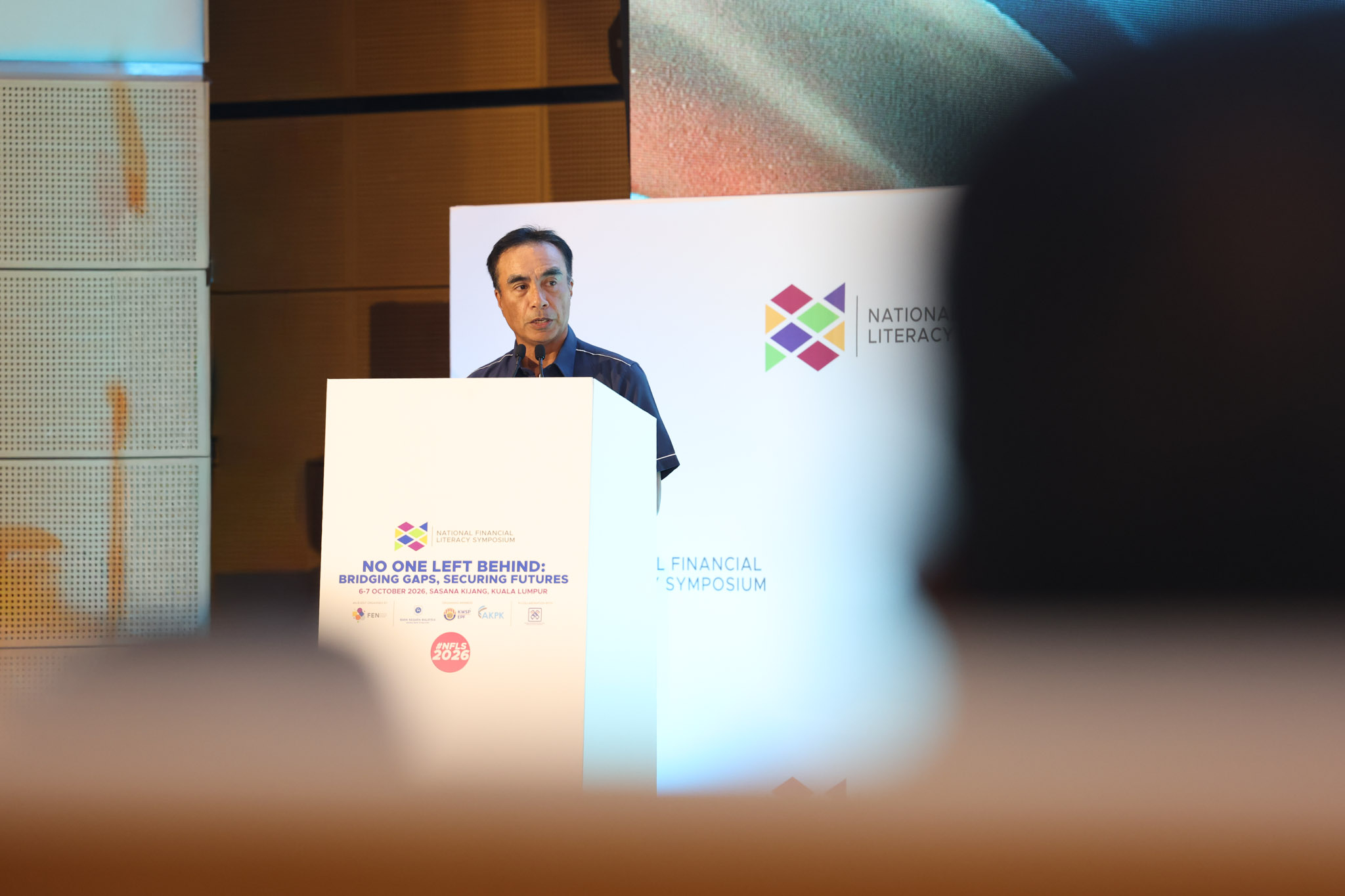
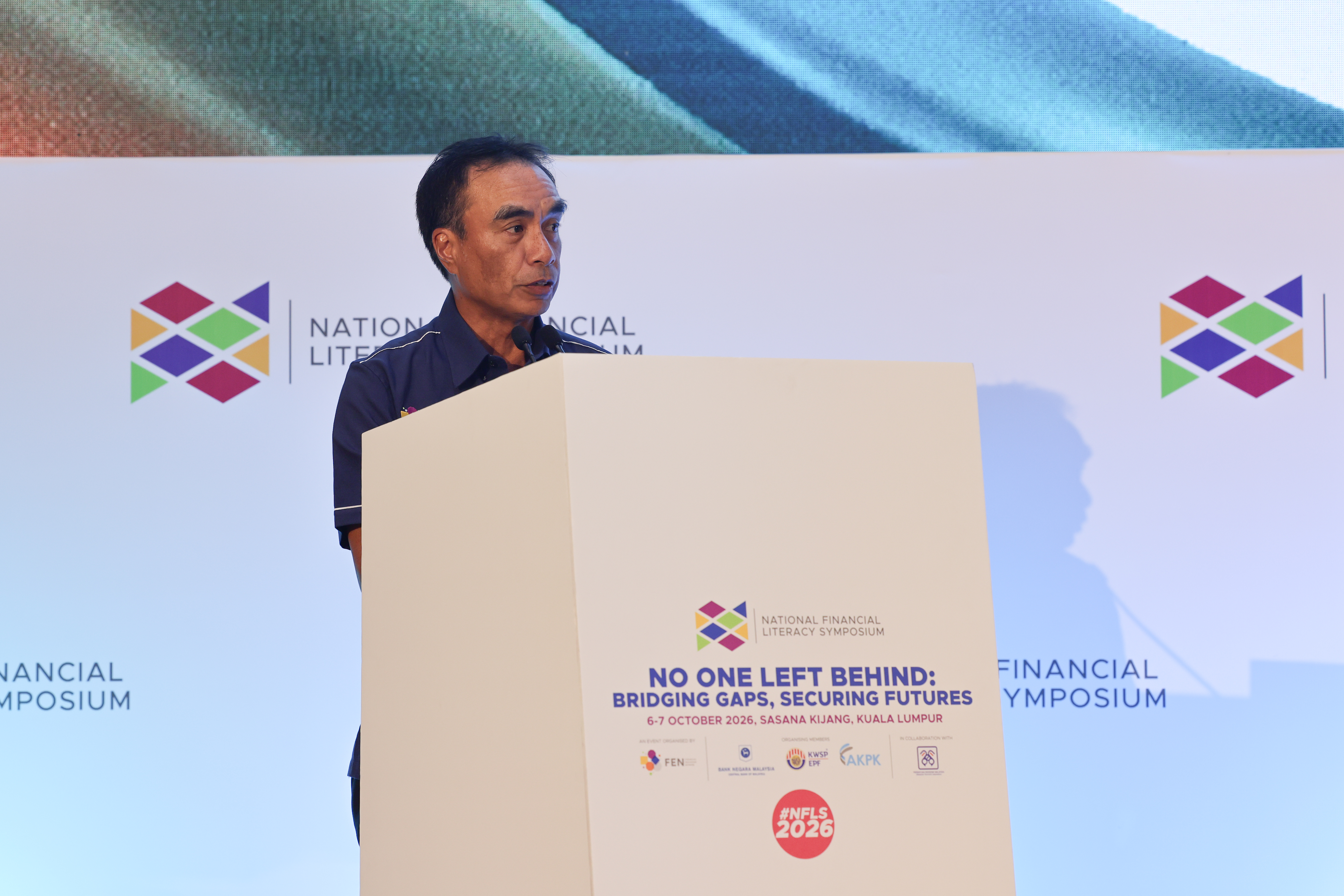
Adnan Zaylani, Deputy Governor of Bank Negara Malaysia delivering his welcoming remarks at the official launch of Financial Literacy Month 2026
Adnan Zaylani, Deputy Governor of Bank Negara Malaysia delivering his welcoming remarks at the official launch of Financial Literacy Month 2026
