Speeches & Interviews
Filter by year
Filter by speaker
Search title in Speeches
Filter by year
Filter by speaker
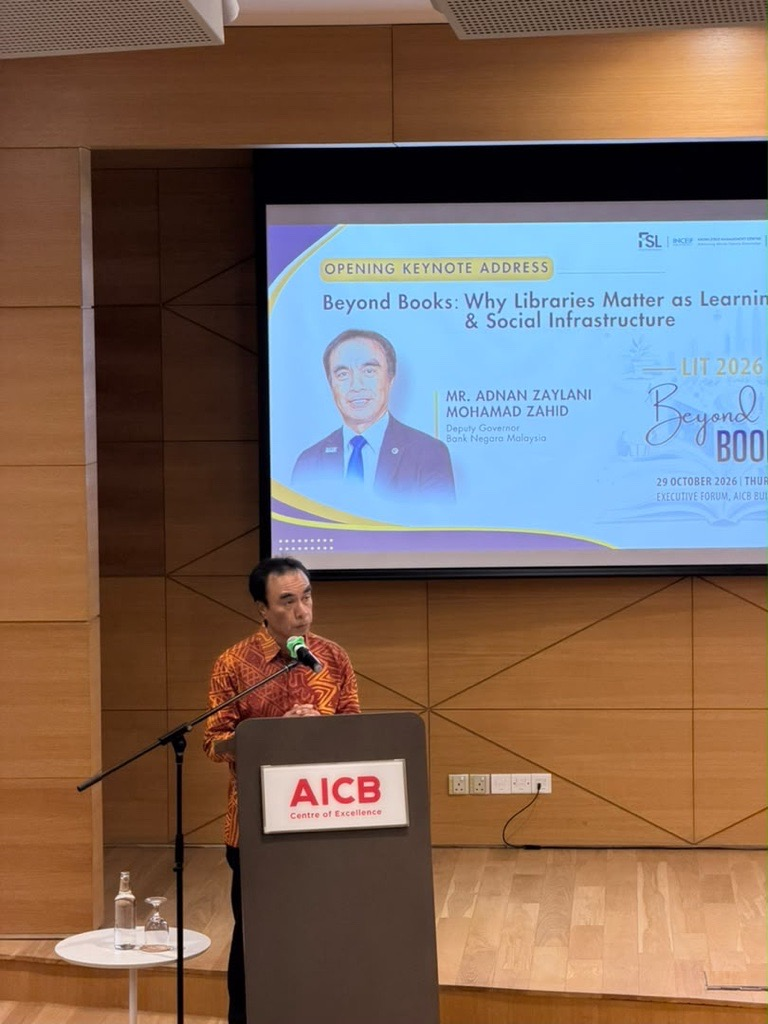
Keynote Address by Deputy Governor Adnan Zaylani Mohamad Zahid
at Beyond Books: Library & Learning Innovation Talk 2026
Kuala Lumpur | 29 October 2026
It is a pleasure to join you today for the inaugural Beyond Books: Library & Learning Innovation Talk 2026, or LIT 2026.
Let me begin by congratulating the Financial Services Library (FSL), together with Asia School of Business (ASB) and INCEIF University, for putting this programme together. The theme Beyond Books poses an interesting and important question. Being an avid book reader, I couldn’t help but eagerly accept this opportunity to share my thoughts on this. I have to admit though, I hardly ever find myself in any library these days but I am certainly happy to be here today.
My own meaningful experiences in libraries was in secondary boarding school and all the way to my university days. At first, and in the 80s, in a rural boarding school in Terengganu, tucked away from the outside world, no TV nor smartphones and internet, the library was a place you could escape from this cocooned existence. Only in the library, can you get the resources and books, to open your minds and travel to distant places, discover unusual things and, my favourite pastime, learn history and civilisations. In my university years, the library was a place of quiet study, and the only place often, that you can get the recommended articles to read, the out-of-print textbooks to refer to.
Many of us of the earlier generations share similar experiences. As students, researchers or professionals, a library has at some point helped us as a place to study, research, find answers or validate ideas. Libraries mattered.
The Changing Landscape
But today, more often than not, some may think libraries are a relic of the past. In this digital age, information and knowledge is at our fingertips, there is no need to clutter ourselves with books, we can go digital. In fact, libraries are hardly visited by working professionals and are mainly frequented rather infrequently by students, researchers and academia.
The digital era has changed the equation. Information has become increasingly abundant and accessible. Vast amounts of knowledge can now be accessed from almost anywhere. There is another inflection point. Artificial intelligence is transforming how information is searched, analysed and even generated.
Given this, what would happen to libraries as we know them?
How do we ensure libraries remain relevant and with a strong purpose?
Allow me to offer my own few reflections on this.
Reflection 1: From Knowledge Repository to Knowledge Hub
First, libraries have, since time immemorial, been repositories of knowledge. Today, knowledge itself is increasingly everywhere and abundant. Making sense of the vast amounts of knowledge, can be challenging. What matters now is the ability to connect people with trusted sources, relevant expertise and meaningful understanding.
Libraries thus have the opportunity to evolve from just knowledge repositories into knowledge hubs. They can help transform information into insight, and insight into action. This is where library professionals become important. Their value lies not only in providing access, but in curating, contextualising and connecting knowledge so users can navigate better in a complex information environment. For a specialised institution such as FSL, this role is especially significant. Its strength lies not in offering the broadest collection, but in providing trusted financial-sector knowledge and helping users derive value from it.
Reflection 2: From Centre of Study to Centre of Innovation
Second, on innovation. Traditionally, libraries have been seen as centres of study, supporting learning and research. That role remains important. But increasingly, libraries also have an opportunity to serve as centres of innovation. In the financial sector, innovation rarely occurs in isolation. It emerges when different perspectives, disciplines and experiences come together.
The same applies to knowledge. Universities generate research. Policymakers provide institutional perspectives. Industry contributes practical experience. Libraries create opportunities for these communities to meet, exchange ideas and generate new thinking.
This principle already is being reflected in initiatives such as the Global Islamic Economist Programme launched by INCEIF University, Bank Negara Malaysia and the Islamic Development Bank. The programme is designed specifically to bridge academic theory with practical policymaking and develop future talent in Islamic economics and finance.
We also see it reflected in the collaboration between FSL, ASB and INCEIF. The value lies not only in bringing institutions together, but in creating new opportunities for learning, experimentation and innovation.
Reflection 3: From Place of Knowledge to Place of Culture
Third, libraries are ultimately about people. Libraries today can bring people together. In this, libraries have the opportunity to evolve from places of knowledge into places of culture. They create spaces that encourage curiosity, dialogue and lifelong learning. They create spaces for diversity, tolerance and respect for each other to thrive.
For students, this means connecting classroom learning with real-world challenges while gaining a better understanding of different communities, perspectives and experiences. For library and knowledge professionals, it means continuously adapting their skills while creating spaces for learning, dialogue and connection.
Even as technology evolves, the importance of culture, values and human connection remains unchanged. In a diverse society such as Malaysia, libraries can be another place that helps foster understanding, respect and a shared sense of community. Ultimately, resilient institutions are built not only on systems and infrastructure, but on people who continue to learn, adapt and grow together.
Before I conclude, I just would like to acknowledge as well as encourage all of us to reflect on the decline of reading as a culture and the view of shallow thinking in the digital age. Indeed, this is the challenge before us and hence why events such as this could be important junctures for us to take stock and reinvigorate the culture.
One final thought. The future of libraries should not be judged by how digital, sophisticated or innovative they become. The more important thing is whether they continue to create value for people and institutions.
If we can answer these questions positively, libraries will remain important not despite technological change, but because of it. For FSL, ASB and INCEIF, there is an opportunity to think beyond individual institutions and consider what could be achieved collectively.
Together, we can contribute not only to knowledge access, but also to the development of a broader financial-sector knowledge, innovation and a culture hub. I hope LIT 2026 becomes one platform that advances that journey.
Thank you.