Speeches & Interviews
Filter by year
Filter by speaker
Search title in Speeches
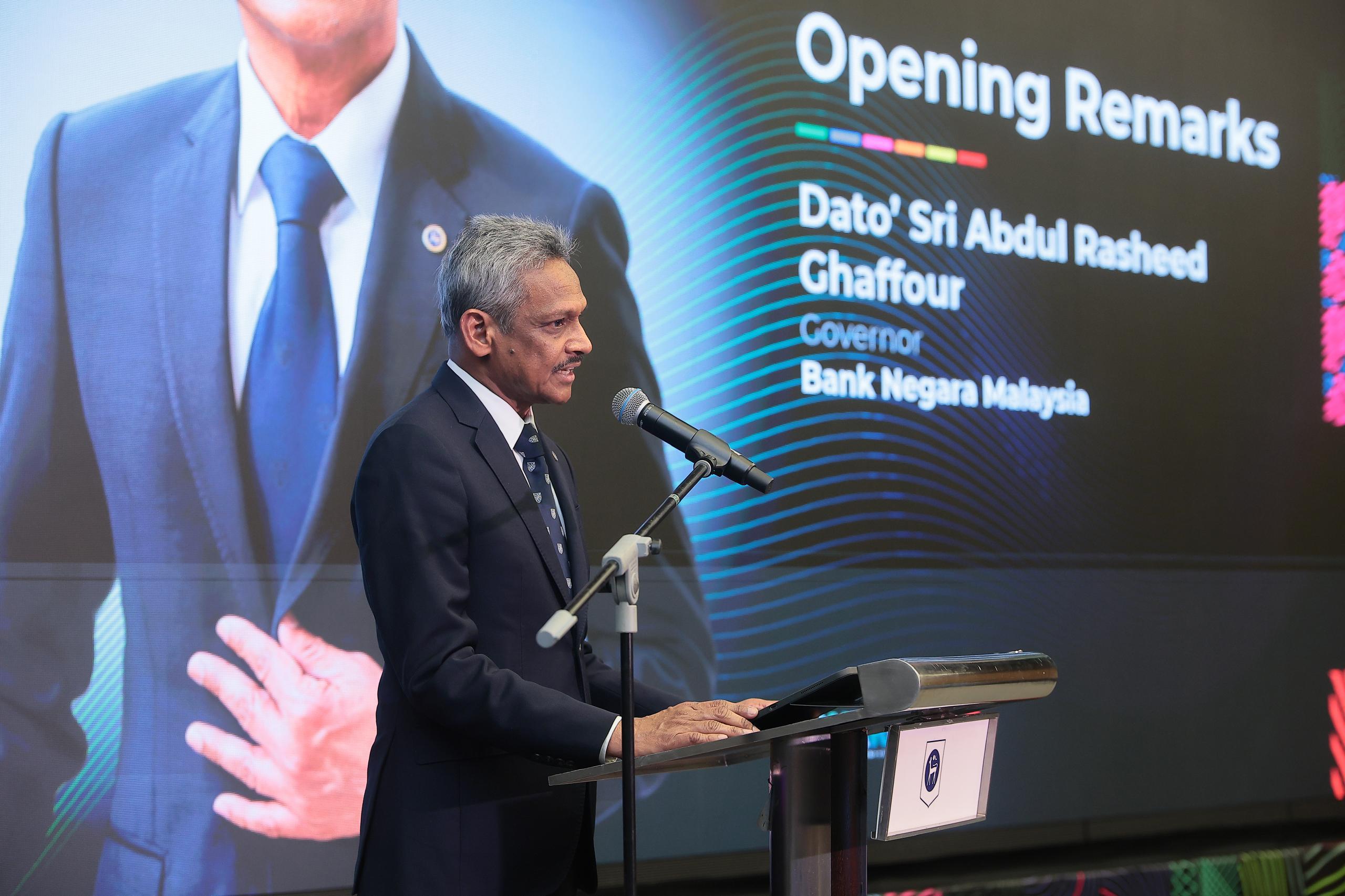
Opening Address by Governor Dato' Sri Abdul Rasheed Ghaffour
at the Currency Conference of Southeast Asia 2026 (CURRENSEA)
Sasana Kijang | 23 November 2026
Let me begin my opening address with something rather ordinary, “a banknote”.
Most of us carry it in our pockets or wallets. We use it, receive it and pass it on, rarely stopping to consider what stands behind it. Yet, that ordinary banknote represents something profound. It is one of the most tangible expressions of the trust that people place in a central bank. Much of central banking takes place beyond the public’s sight. Monetary policy, reserves and supervision largely operate in the background.
Currency is different. People literally carry our promise in their pockets. When someone accepts a banknote or a coin, there is an implicit confidence that it is genuine, that others will accept it, and in the institution standing behind it.
That trust lies at the heart of our responsibility as issuers of currency. The form of money will continue to evolve. But our responsibility to preserve that trust does not.
An enduring mandate in a changing world
Currency issuance is one of the oldest responsibilities of central banks. At its core, that responsibility remains remarkably consistent: to ensure that currency is secure, available and trusted.
But currency is more than a means of payment. It is part of an economy’s infrastructure.
Every day, currency enables transactions, supports commerce and allows households and businesses to meet their needs. And when other payment systems are unavailable, it provides an important source of continuity.
When currency works well, we hardly notice it. Commerce moves. Transactions take place. People go about their lives. But when confidence in currency is weakened, the consequences extend far beyond the banknote itself. It affects confidence in the institutions and economy behind it.
This is why our responsibility matters. It is also why we cannot afford to stand still.
Technology is transforming how currency is designed, produced, authenticated and distributed. Security threats are becoming more sophisticated, supply chains more interconnected and sustainability considerations more pressing.
All this is changing what good currency stewardship requires of us. And perhaps the banknote itself offers us a useful way of thinking about that responsibility.
What a banknote demands of us
Consider again the banknote in your pocket.
In much of the same way, we must build resilience against disruption, keep currency accessible to the public and protect its integrity and value.
A banknote is designed to endure. But durability does not mean remaining unchanged. The same is true of our role as currency issuers.
Our mandate endures. How we deliver it must evolve.
From managing currency to stewarding an ecosystem
That evolution requires us to look beyond the banknote itself. The banknote in someone's pocket is only the visible end of a much larger system.
Behind it sits an ecosystem of institutions, infrastructure, technology and supply chains.
Modern currency stewardship requires us to ensure that this ecosystem remains resilient as technology, economies and societies change.
That means managing increasingly complex threats and dependencies, harnessing technology without creating new vulnerabilities, and improving sustainability without compromising reliability.
Ultimately, success is not measured by how many banknotes or coins we issue. It is measured by whether the person holding that banknote can continue to place their confidence in it.
For that to happen, the ecosystem behind it must work reliably, efficiently and securely.
Learning from one another
We have different jurisdictions, economies and payment landscapes. Even the role and use of cash within our societies differ.
Our answers will not always be the same. Nor should they be. But many of the challenges we face are increasingly shared. That is where this conference, CurrenSEA, has an important role.
It gives us a space to exchange experiences candidly, challenge established thinking, and learn both from what has worked and what has not.
None of us can afford to learn only from our own experience.
Each of us remains responsible for the currency entrusted to us.
But all of us can become better stewards when we learn from one another.
That is the spirit in which I hope we will approach the coming days.
Maintaining trust through change
Tomorrow morning, someone may take a banknote from their wallet. They will know nothing about the discussions taking place in this room on technology, security, resilience or sustainability. Nor should they need to.
They simply expect the currency to work.
That simple expectation carries a profound responsibility. Our task, therefore, is not to preserve today’s currency system unchanged.
Our task is to prepare for what comes next.
The banknote in someone’s pocket may appear ordinary. But the trust it carries is everything. It was our responsibility in the past. It is our responsibility today. And whatever form money takes in the future, it will remain our responsibility tomorrow.