Speeches & Interviews
Filter by year
Filter by speaker
Search title in Speeches
Filter by year
Filter by speaker
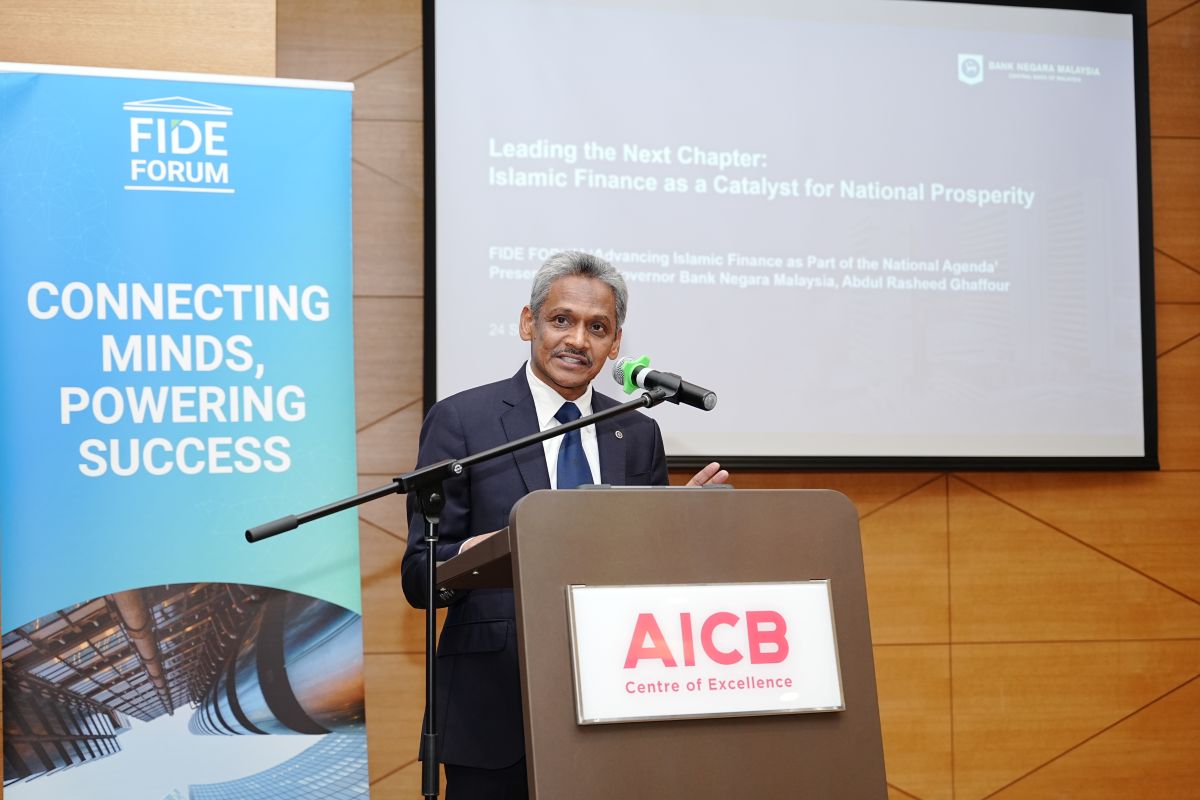
Presentation by Governor Abdul Rasheed Ghaffour
at FIDE Forum: Advancing Islamic Finance as Part of the National Agenda
Kuala Lumpur | 24 September 2026
'Leading the Next Chapter: Islamic Finance as a Catalyst for National Prosperity'
Malaysia’s economic story has never been static. Our development experience has been characterised by successive economic transformations. Malaysia’s economy has expanded nearly 17-fold since 1990, with a continuous shift in the drivers of growth. We moved from building the foundations of the economy, to broadening participation, industrialising and progressively moving up the value chain.
Each phase brought new sources of growth and greater economic complexity. And today, that transition continues in a more challenging global environment, with softer global growth, greater fragmentation and thinner external buffers, given the challenges faced past few years. The task is no longer merely to expand economic activity, but to build an economy that is productive and resilient.
As of today, the GDP has exceeded beyond RM2 trillion, with growth expected to remain around 4–5% in 2026. The challenge is not simply to sustain growth but to strengthen its quality. As Malaysia move into the next phase, we see at least four important shifts:
This brings us to the question of how capital should be allocated in the years ahead. As the economy matures and growth transitions, productivity will increasingly determine how much further we can expand our growth potential. Strengthening Malaysia’s productive capacity requires capital to flow to the right places.
Here, banks have a pivotal role to play. Their financing decisions will be critical in shaping the country’s next phase of growth. As the primary intermediaries of domestic capital, banks remain the cornerstone of Malaysia’s financial system.
These priorities are not occurring in isolation. They are increasingly embedded across Malaysia’s national development strategies. The 13th Malaysia Plan and the New Industrial Master Plan (NIMP) 2030 set the broader direction, while sectoral strategies, including National Semiconductor Strategy (NSS), National Energy Transition Roadmap (NETR), and Halal Industry Master Plan (HIMP) 2030, to provide greater clarity on the capabilities and industries we want to build. We are also becoming more deliberate about the quality of investment. The New Incentive Framework shifts the emphasis beyond investment volume. It places greater weight on the value that investment creates for the economy. Collectively, these strategies set a clearer direction for the capabilities and investments Malaysia needs to build.
Yet, when we look at where financing is flowing today, there remains a gap between our ambitions and outcomes. Despite strong policy ambitions laid in our national master plans, financing to catalytic priority sectors has remained relatively modest, with lending approvals continuing to be concentrated in services.
While financing for manufacturing has improved over time, it remains limited relative to the scale of investment required to build globally competitive industries. These frictions do not reflect a lack of willingness on the part of banks. Rather, they point to information gaps, structuring complexity and capability as well as sector familiarity, and these are gaps that we can collectively address.
Perhaps a more important question for us to answer today is - “Are we still financing yesterday’s economy, or are we positioning ourselves for the next one?”
As Islamic finance has grown into a significant part of Malaysia’s financial system, it needs to evolve in tandem. In fact, it needs to lead in this endeavour, The next challenge is to ensure that scale translates into greater relevance to where the economy is heading. As economic activity becomes more complex, traditional financing approaches may no longer be sufficient. This includes developing more sector-focused solutions, longer investment horizons, and structures that can accommodate different risk profiles.
Over the past decade, Islamic banking’s share of total financing has nearly doubled since 2015 from 25% to 48%. This growth is not only relative. We see similar depth in the Islamic capital market. Its size has increased from RM420 billion to RM670 billion during the same period, while its market share has remained dominant at above 60%. Islamic finance is therefore no longer at the periphery of the financial system, rather it is one of its principal channels of intermediation.
Importantly, this scale is supported by a broad institutional ecosystem. Behind these numbers are established capabilities in product structuring, Shariah governance, risk management and capital mobilisation. The foundations are therefore already in place. Next, how do we then translate this strong market position into financing that supports productive investments and better societal outcomes? And talent that understands not only Islamic finance, but increasingly in technology, new sectors and more complex financing structures?
These strengths are already familiar to us - risk-sharing, broader sources of capital, and structures that can be tailored to different economic needs. And this is where Islamic finance has a natural advantage. The opportunity is for us to deploy these advantages more deliberately now particularly where financing needs are longer-term, more specialised, or less well served by conventional approaches. That is where I believe the next phase of Islamic finance needs to be anchored - not in novelty, but in relevance and impact that we can bring to the economy. This goes back to the fundamental behind the Value-based Intermediation initiative.
While the industry's existing capabilities have served it well in established sectors, new capabilities may be needed to support emerging growth opportunities. This requires us to think about capability across the entire financing value chain. The objective is not to build every capability, but to build depth in areas most relevant to the institution’s strategic priorities. This includes:
Nonetheless, capabilities and ecosystems will only take us so far. Ultimately, someone has to set the ambition and put them to work. This brings me to the most important ingredient: the role of leadership. The next phase of Islamic finance cannot be delivered by industry leaders acting separately. It will require collective stewardship, with each part of the institution taking responsibility for where Islamic finance goes next. In this regard, no single institution can pursue every opportunity.
For Boards, the key question is: where can we make the greatest difference? The challenge is to identify the areas where the institution is best positioned to contribute. But setting an ambition is only the starting point. It must be reflected in decisions around risk appetite, capital allocation and how success is measured.
For CEOs and management teams, the focus then shifts to execution. How do we translate that ambition into viable opportunities and tangible outcomes? This may require building new capabilities, whether through deeper sector expertise, better use of data, specialised talent or stronger partnerships across the broader ecosystem.
For Shariah Committees, the question is equally important: what outcomes are we ultimately seeking to create? Their role is most impactful when engaged early in the process. This enables Shariah considerations to support innovation in a way that remains true to its principles while delivering meaningful value for the economy and society.
While the responsibilities of Boards, management and Shariah committees may differ, their efforts must remain aligned. A shared understanding of priorities, trade-offs and desired outcomes is critical. In the end, the true measure of leadership is not the ambition we articulate. It is whether we can build the capabilities, mobilise the resources and deliver the outcomes needed to make that ambition a reality.
And this challenge does not only sit for Boards and management. It applies equally to us as regulators. Our roles has to move from regulating what already exists, to enabling what should exist.
In Islamic finance specifically, we work to ensure that our frameworks allow the industry to use the full breath of Shariah contracts. But enabling does not mean lowering the bar. As market becomes more sophisticated, our expectations around governance, investor protection, transparency and risk management become equally sophisticated. Ultimately, we should judge ourselves by the same test we are placing on the industry: are our actions as regulators helping finance serve the real economy better?
While an enabling framework is important, progress will ultimately depend on whether the capabilities needed to execute can come together effectively across the ecosystem. We must recognise that not every capability needs to sit within a single institution. Institutions will therefore need to look beyond what sits within their own walls and draw more actively on the wider ecosystem, whether for technical expertise, additional capital or risk-sharing capacity. In many cases, the building blocks are already there. They sit across different financial institutions, institutional investors, public sector and technical partners. The next step is to connect these capabilities more deliberately around the needs of the nation.
So, what are the needs and aspirations of the nation that Islamic finance should seek to support? This is something BNM has been thinking about in our ongoing work to come up with the Financial Sector Blueprint 2027–2030. Studying the various masterplans at the national level, and economic needs on the ground, several long-term national aspirations became apparent to us.
Taken together, they paint a picture of the Malaysia we want to build - A nation where people live longer, healthier and more financially secure; growth creates better jobs and higher incomes; businesses and livelihoods remain sustainable; and the economy becomes more resilient and greener over time. This is where Islamic finance must demonstrate its purpose. Its success should be measured not only by growth or Shariah compliance, but by how effectively it mobilises capital to improve human welfare and support a flourishing society.
By bringing together credit, equity and philanthropic capital, Islamic finance can connect these national aspirations with tangible economic and societal outcomes. That is the opportunity before us, for Islamic finance not merely to participate in Malaysia’s next chapter, but to help shape it.
To be read together: Presentation Slides