



Breadcrumb

FFA - what is FF

In Malaysia, financial services may only be offered by those licensed under specific laws and regulations, administered by very few government agencies such as BNM, and selected ministries. Learn how to identify legitimate ones, be aware of suspicious activities, and avoid becoming a victim of financial fraud.

What is financial fraud, or scam?

Financial fraud can be broadly defined as an intentional act of deception involving financial transactions for purpose of personal gain. Fraud is a crime, and is also a civil law violation.

CA - illegal schemes

Illegal or Suspicious Financial Activities

The following financial activities are prohibited under relevant legislations administered by BNM. Members of the public are advised to alert BNM on any illegal or suspicious activities or entities.

Illegal Foreign Exchange Trading Scheme

Illegal Foreign Exchange Trading Scheme refers to the buying or selling of foreign currency by an individual or company in Malaysia with any person who is not a licensed onshore bank or any person who has not obtained the approval of Bank Negara Malaysia under the Financial Services Act 2013 or Islamic Financial Services Act 2013.

This scheme involves the act of buying or borrowing foreign currencies from or selling or lending foreign currencies to a non-licensed onshore bank.

It can also be in the situation where the non-licensed onshore bank does an act that involves, is in association with, or is preparatory to, buying or borrowing foreign currencies from, or selling or lending foreign currencies to, any person outside Malaysia.

Illegal operators usually operate on a small scale and claim they can provide remittance services efficiently, without the need for any documents or identification. They rarely use documents to validate and verify the transactions. By engaging in these transactions, customers run the risk of being cheated and their funds may never reach its intended destination.

Illegal operators usually target job seekers by placing attractive advertisements to lure prospective employees to join the company, after which they use them to solicit for new investments. Most often, employees will be encouraged to approach their direct family, relatives and friends before targeting members of the public.

Illegal operators usually portray a professional and reputable image, a high-tech office layout and advanced IT facilities, such as a LCD screens displaying movements in exchange rates to provide the impression that a legitimate and real business is being conducted. These facilities are merely a false front.

Investors can either trade using their trading accounts with the company or through dealers appointed by the company. In some cases, investors are allowed to operate their accounts via the Internet.

Investors are also required to sign a business contract which is normally entered between the investors and a principal company overseas.

In most instances, the operators will inform the investors that they will have to send these contracts to its principal company overseas for signing. However, such contracts are usually left unsigned.

As such, in the event the investors are unhappy with future dealings and transactions, no action can be taken against the company as there is no binding contract between them.

Investors will usually get high returns on their initial investments. This will convince them to increase their investments in hopes of higher returns. Eventually, they will end up losing everything when the illegal operators suddenly go missing.

Investors who lose their money through purported volatility of exchange rate movements are informed by the illegal operators that they need to pay margin-call in order to recover their paper lose.

The illegal operators may also encourage investors to increase their investment to try to recover their losses.

  • Deal only with licensed onshore banks;
  • Check with the relevant authorities before remitting/ investing/ depositing;
  • Be extra careful with investments over the internet;
  • Be skeptical of any investment opportunity that is not in writing; and
  • In case an investment has been made, keep copies of all the investment and communications.

You can report directly to Bank Negara Malaysia via the following communication channels:

Web: eLINK Form

Call: 1-300-88-5465 (1-300-88-LINK)

Fax: 03-2174 1515.

Illegal Money Services Business Activities

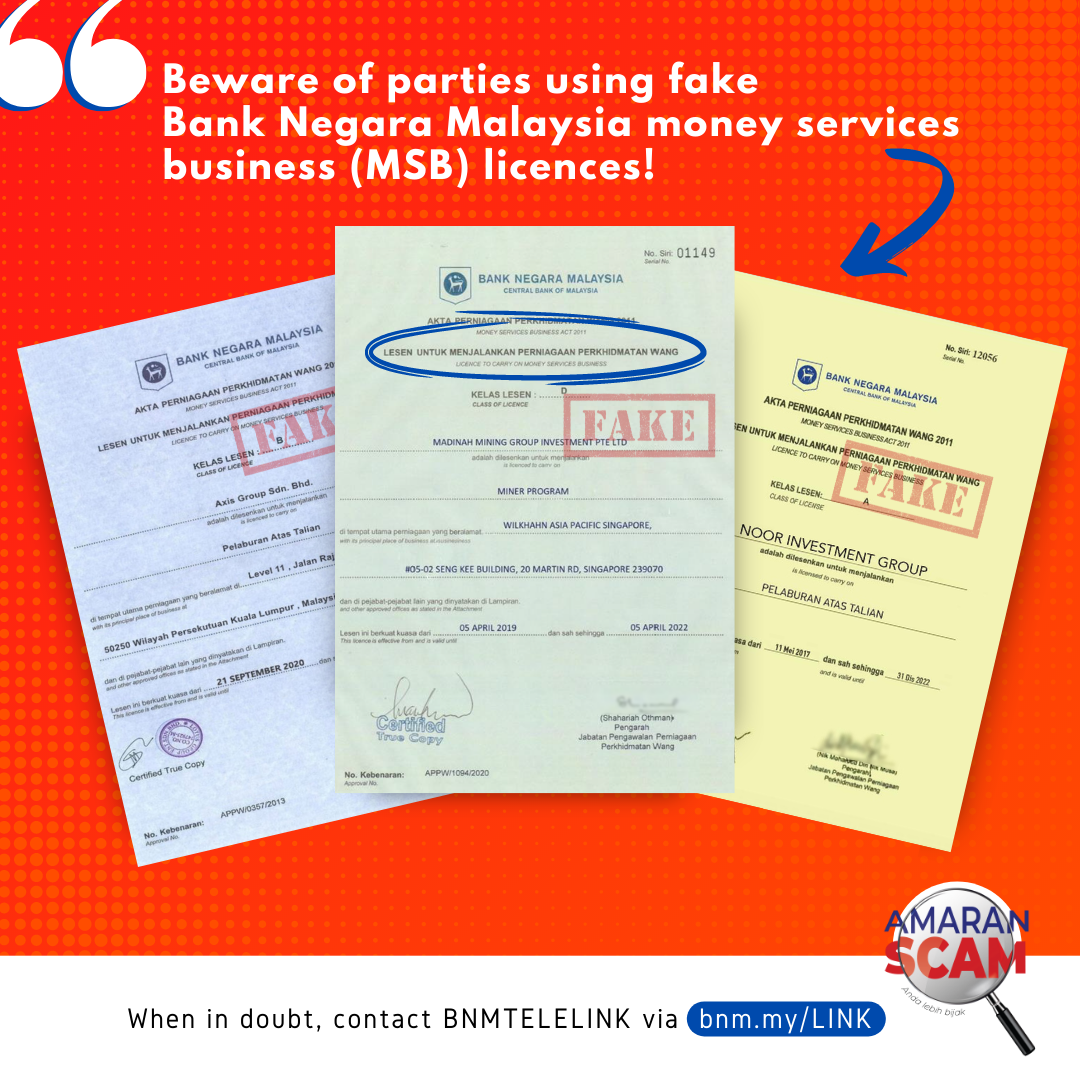
Money Services Business includes money changers, remittance service providers and currency wholesalers. Operators require a license from BNM under the Money Services Business Act 2011. The license must be displayed prominently at the place of business.

You can report directly to Bank Negara Malaysia via the following communication channels:

Web: eLINK Form

Call: 1-300-88-5465 (1-300-88-LINK)

Fax: 03-2174 1515.

Illegal Deposit Taking

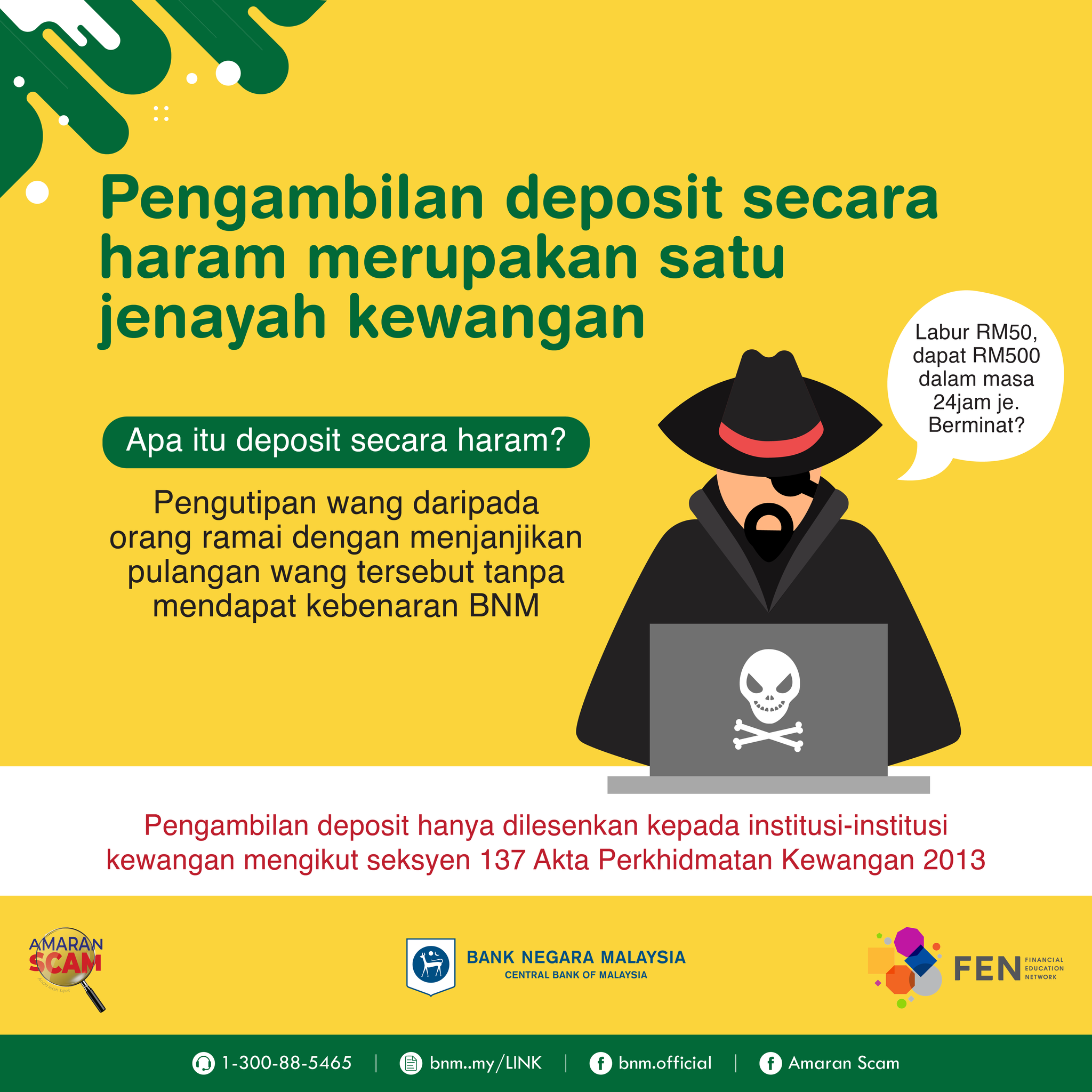
Only licensed financial institutions under the relevant laws administered by BNM is allowed to accept deposits.

Illegal Internet Investment Scheme

Illegal Internet Investment Scheme is a variation of illegal deposit taking activities which employs the use of internet (e.g: through emails and websites) as a primary channel for interaction, communication and transaction of business engaged in fund management and investment advice without any licence.

Illegal investment schemes are those companies or individuals that are dealing in securities, trading in future contracts, and providing fund management services and investment advice and related to securities or futures without being licensed by the Securities Commission under the Capital Markets & Services Act 2007.

In addition, fund managers are required to hold a fund manager's licence under Section 15C of the Securities Industry Act 1983.

With the Internet becoming a common part of daily life, it should be no surprise that fraudsters have made cyberspace a prime hunting ground for new victims.

The Internet has made it simple for fraudsters to reach out to millions of potential victims at minimal cost.

Many of the online scams we see today are merely modified versions of old schemes that have been used to fleece offline investors for years.

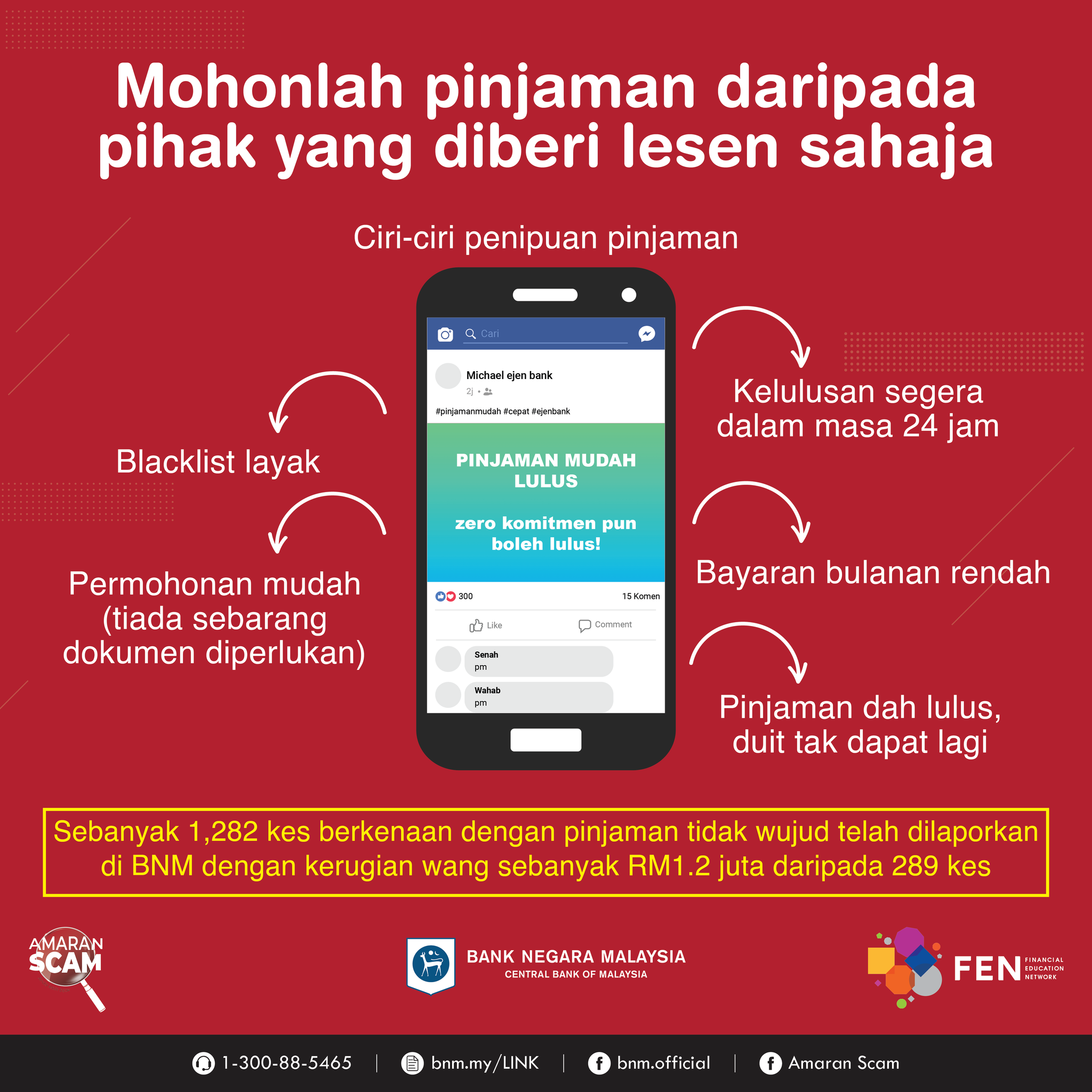
Operators of illegal internet investment schemes lure unsuspecting victims to make on-line investments or receive investment advice online, by offering investment opportunities above a market rate of return and will claim that their schemes are at zero or very low risk.

When questioned, most illegal operators will either claim to be foreign operators that do not require licenses from Malaysian regulators to operate their business, or claim that they already have the appropriate license from relevant authorities/regulators.

Unsuspecting victims of these schemes would be enticed as operators will pay them high returns at the initial stage and this is used as a tactic to lure and recruit new investors.

The survival of this scheme is dependent upon the recruitment of new depositors, i.e., funds obtained from new depositors will be used in paying dividends to the existing depositors. Therefore, the scheme will fail when there is no contribution of funds from new depositors; and

However, the operator will eventually abscond with deposits collected when he feels that the scheme is about to fail, thus leaving the depositors at the losing end.

These operators are not licensed to receive deposits by Bank Negara Malaysia or licensed to offer investment advice from the Securities Commission related to fund management, securities and futures.

  • Remember the golden rule - if it sounds too good to be true, it's probably a lie;
  • Deal only with licensed financial institutions and authorised dealers;
  • Check with the relevant authorities before investing/ depositing;
  • Don't be pressured or rushed to invest;
  • Be extra careful with investments over the internet;
  • Be sceptical of any investment opportunity that is not in writing; and
  • In case an investment has been made, keep copies of all the investment and communications

The approach by the operators may have been made by mail, telephone, Internet or in person, but the intention is always the same, that is, to take money from unsuspecting victim for goods or services that they have no intention to provide.

Schemes which promise interest rates, returns or profits, which are much higher than the returns offered by licensed financial institutions for their deposits.

The promises of high returns are aimed at attracting the members of the public to participate in the schemes and the investors may not be given copies of any documentation including agreements by the operators.

There is also no assurance that the operators of such schemes can continue to pay the high returns.

At the beginning of such schemes, the operators are able to use money received from subsequent depositors to pay high returns or to repay the principal amount to the earlier depositors.

However, the operators could not invest the deposits in equally or more lucrative ventures or investments and therefore unable to sustain the high returns or repayment promised to their depositors.

These schemes will fail eventually when there are no new deposits being continually received by the operators. At such time, the "get-rich-quick" schemes will collapse and the depositors or investors will lose their investments.

You can report directly to Bank Negara Malaysia via the following communication channels:

Web: eLINK Form

Call: 1-300-88-5465 (1-300-88-LINK)

Fax: 03-2174 1515.

Unauthorised Withdrawals

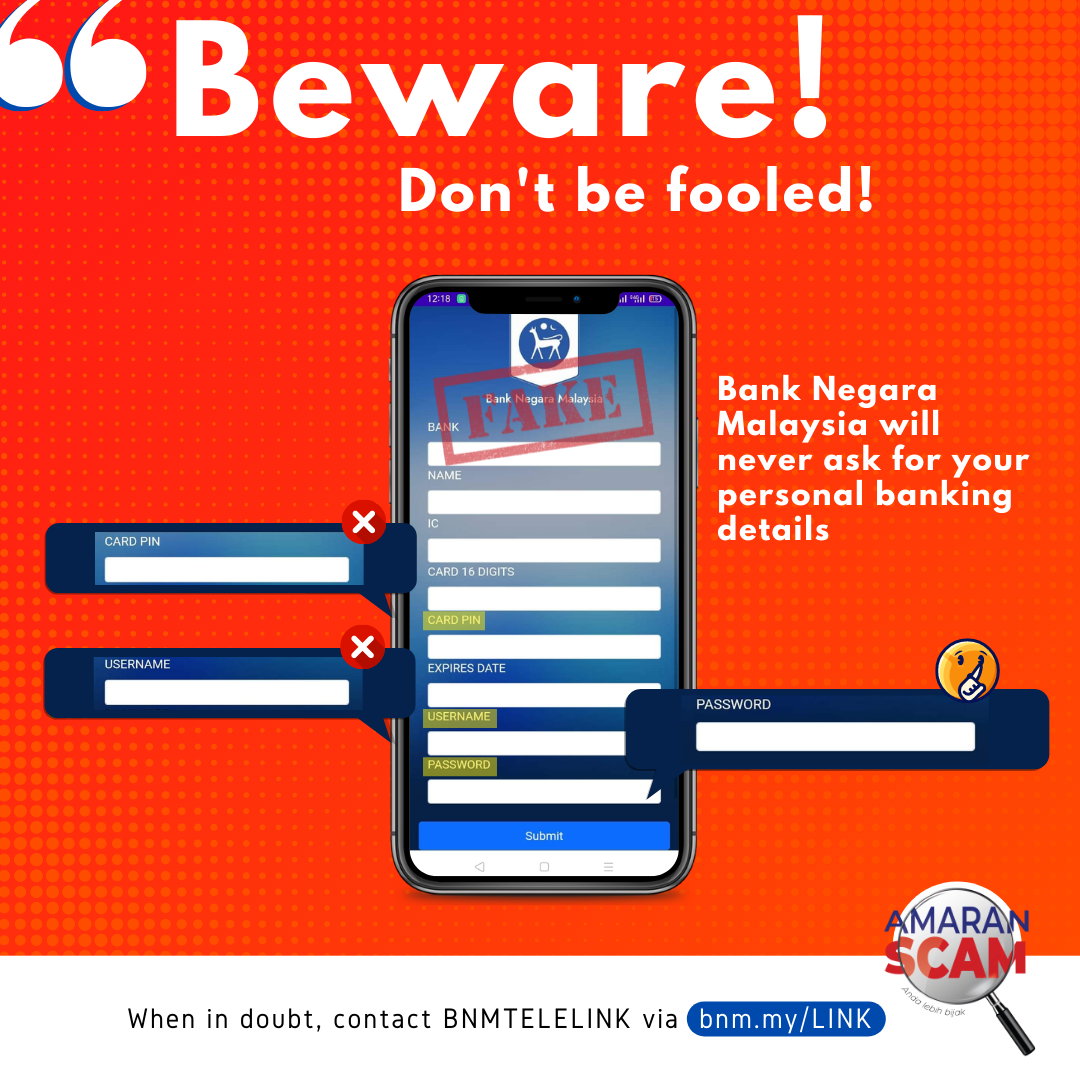
Unauthorised Withdrawal involves the withdrawal or transfer of funds from an individual's banking account without proper authorisation or consent by the individual. Such incidents are normally the result of an individual knowingly, or unknowingly, divulging their personal information such as personal identification numbers (PIN) and password to fraudulent or third parties.

A total of 400 complaints on unauthorised withdrawals were received by Bank Negara Malaysia in 2009 (165 similar complaints in 2008). Based on investigations, all of these cases were due to customers knowingly or unknowingly divulging their personal information such as personal identification numbers (PIN) and passwords to third parties or fraudulent parties.

The transactions involved were genuine, using complainants' account information and followed the required process. CCTV recordings had captured the complainants activating access to Internet banking at ATMs.

Most complainants were not Internet savvy and failed to understand that their own actions had led to the fraudulent withdrawal of funds from their accounts.

In most cases, victims of unauthorised withdrawals had received an unidentified SMS (from fraudster) to inform them that they have won a cash prize.

To claim the promised cash prize, the victim is informed that they have to open an internet banking account.

The victim then contacts the fraudster and the fraudster will provide a step-by-step guide on how to register and activate their internet banking account using the ATM terminal.

At point of registration at the ATM terminal, the victim will be given an internet banking personal identification number (PIN). The fraudster will ask the victim for this PIN and use it to create an internet banking account for the victim.

The fraudster will then ask the victim to register the fraudster’s mobile phone number in order to obtain an Authorisation Code to enable transfer of funds via internet banking.

This will result in the Authorisation Code being sent via SMS directly to the fraudster’s mobile phone. The victim has now unknowingly provided the fraudster with full access to their banking account.

Do not respond to 'too good to be true" SMS or Whatsapp or call from unknown person;

Be skeptical of any SMS claims that you have won cash prizes in competitions you never enter;

Be extra careful - protect your personal banking details and never reveal your PIN to anyone; and

In case an arrangement has been made, keep copies of all the communication records and documentation

You can report directly to Bank Negara Malaysia via the following communication channels:

Web: eLINK Form

Call: 1-300-88-5465 (1-300-88-LINK)

Fax: 03-2174 1515.

Unauthorised Use of Credit or Debit Card

Unauthorised Use of Credit or Debit Card is a transaction involving the charging of expenses/purchase of goods and services without the consent of the cardholder. Such transactions may occur as a consequence of credit or debit cards that are lost, stolen, not received, issued on a fraudulent application, counterfeit or other fraudulent conditions as defined by the credit or debit card issuer.

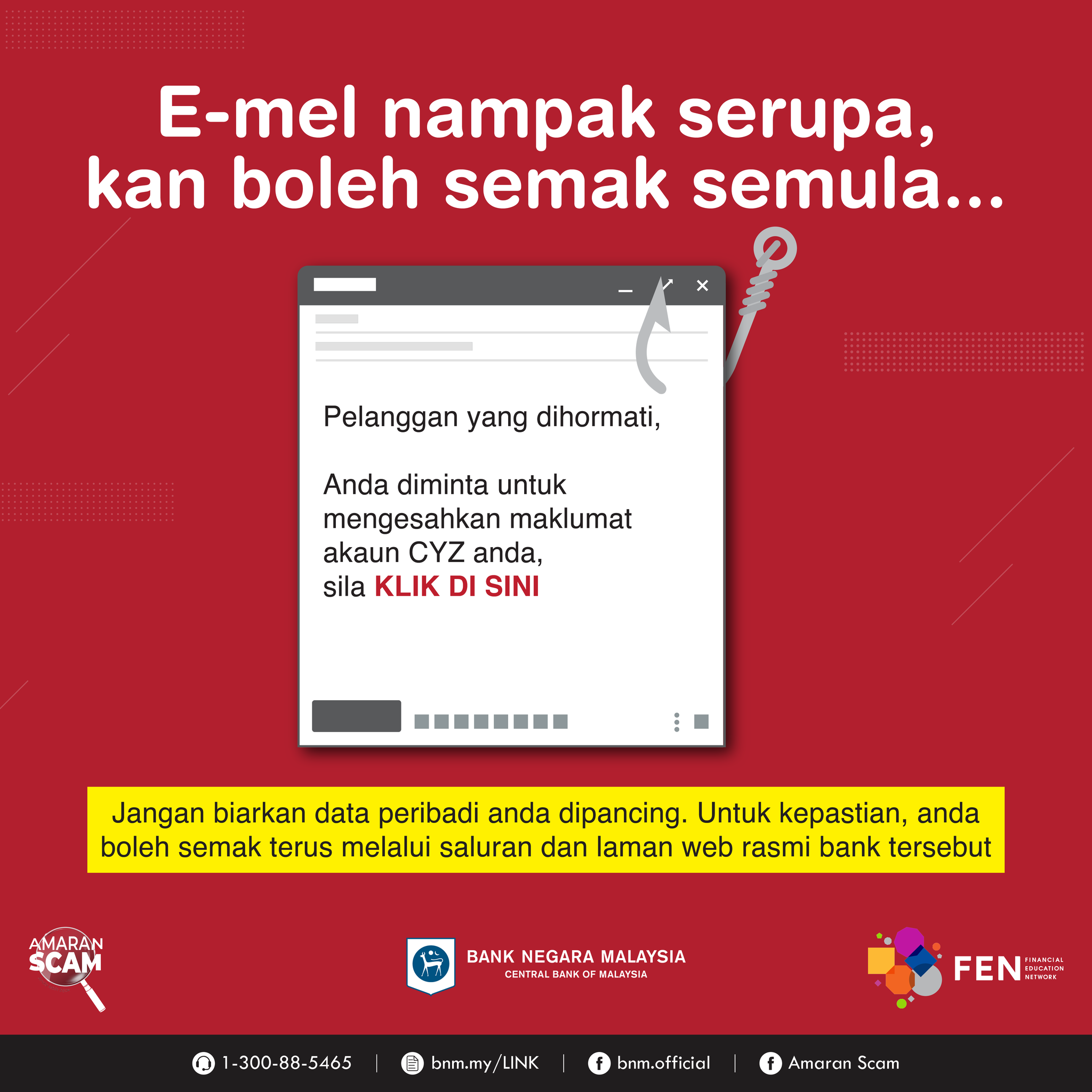
Fraudsters are no longer just using SMS to elicit contact with unwary members of the public in an effort to extract personal banking information for unlawful purposes.

Victim receives SMS or Whatsapp or telephone call: Requesting victim to confirm a credit card transaction for the purchase of goods or services purportedly charged to the victim's credit card.

When victim calls the telephone number provided in the SMS, the fraudsters identify themselves as agents of a commercial bank, and again, ask the victim to confirm whether the credit card transaction had taken place.

When victim informs the fraudster that he has no such credit card or transaction, the fraudster will start to sound concerned and will advise victim to lodge a report with Bank Negara Malaysia's "Unit Kad Kredit Palsu", or with the commercial bank's "credit card management department". The fraudster will provide the victim with the telephone number for the "Unit Kad Kredit Palsu".

When victim calls the telephone number provided, they are greeted by a automated voice message which identifies the company as Bank Negara Malaysia, and the call will then be answered by someone claiming to be a Bank Negara Malaysia officer. This officer will request for information relating to the victim's banking and credit card accounts under the pretence of lodging a complaint on behalf of the victim.

The fraudsters now have sufficient information to illegally transfer funds out of the victim's bank account or to conduct illegal transactions through the victim's credit card account.

Do not respond to SMS or call from unknown person asking for your credit/debit card details.

If someone claiming to be from your card service provider calls you and asks you to confirm the security numbers on the back of the card (the last three digits on the back of the card), you should end the call immediately;

Be sceptical - Bank Negara Malaysia officer will never call you to ask for your credit/debit card or banking particulars; and

In case an arrangement has been made, keep copies of all the communication records and documentation.

You can report directly to Bank Negara Malaysia via the following communication channels:

Web: eLINK Form

Call: 1-300-88-5465 (1-300-88-LINK)

Fax: 03-2174 1515.

XXX

XXX.

You can report directly to Bank Negara Malaysia via the following communication channels:

Web: eLINK Form

Call: 1-300-88-5465 (1-300-88-LINK)

Fax: 03-2174 1515.

Misuse of Bank Negara Malaysia and Senior Officers' Names and Positions

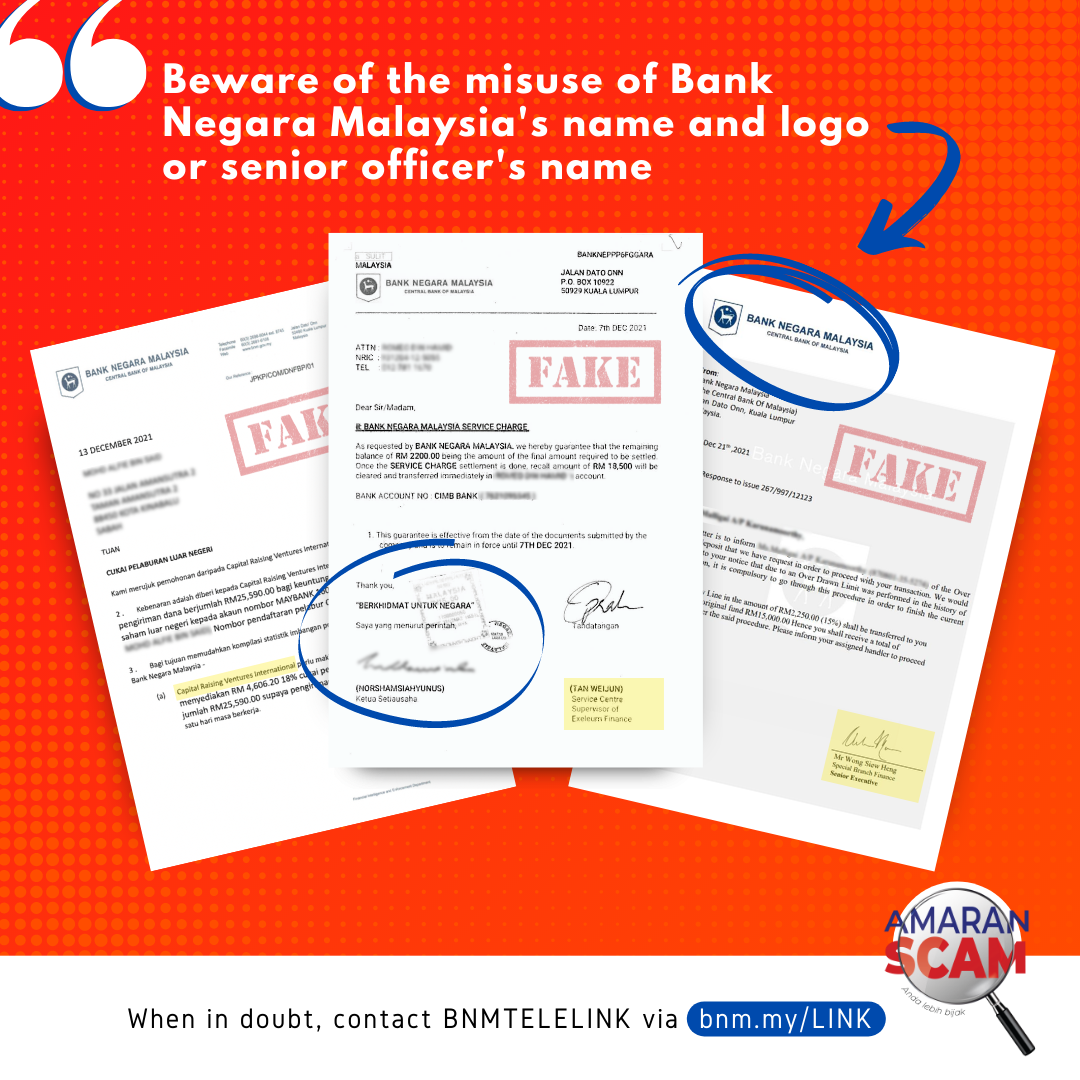
The fraudulent use of Bank Negara Malaysia's name, corporate logo as well as Senior Officers' names and positions by fraudsters in illegal schemes or fraudulent activities in order to mislead members of the public. The illegal schemes or fraudulent activities may be promoted through emails, letters, phone calls or other forms of communication.

If someone claiming to be from Bank Negara Malaysia calls you and talk you into joining any investment schemes or suspected fraudulent activities, you should end the call immediately;

You may also verify the claim or identity of the said 'Bank Negara Malaysia officer' by calling the number provided below;

Be sceptical - Bank Negara Malaysia officer will never call you to promote any 'too good to be true' investment schemes; and

In case an arrangement has been made, keep copies of all the communication records and documentation.

You can report directly to Bank Negara Malaysia via the following communication channels:

Web: eLINK Form

Call: 1-300-88-5465 (1-300-88-LINK)

Fax: 03-2174 1515.

CA - learn legitimacy

Who may offer financial services in Malaysia?

Only financial institutions i.e. banks, insurance companies and takaful operators as well as money changers, remittance service providers and currency wholesalers (now known as "money services business") licensed by BNM under the relevant laws and regulations administered by BNM are allowed to provide financial services in Malaysia.

There are types of businesses that are not regulated by BNM, namely:

  1. Capital market and investment activities are regulated by Securities Commission Malaysia (SC)
  2. Credit companies, moneylenders (now known as "community creditors"), and pawnbrokers, are licensed by Ministry of Housing and Local Government (KPKT)
  3. Cooperatives are regulated by Suruhanjaya Koperasi Malaysia
  4. Generally, companies and businesses operating in Malaysia must be registered with, and are subject to regulatory supervision of Companies Commission of Malaysia (SSM)

CA - why careful

Why should consumers be careful when dealing with unregulated entities or persons?

  • Consumer protection under the laws administered by BNM is not applicable should the members of the public choose to deal with the illegal financial service providers.
  • Members of the public who participate in the illegal financial activities could also BE CHARGED under the law as abetting the operators of such illegal activities.

Thus, members of the public ARE ADVISED NOT TO:

  • Deal with any of the illegal financial service providers;
  • Reveal or disclose personal financial credentials to any of the illegal financial service providers; and
  • Involve or associate themselves with any of the illegal financial service providers.

CA - Amaran Scam

Amaran Scam

Keep up-to-date with the latest financial scams in Malaysia and protect yourself and your loved ones. An initiative of BNM and other law enforcement agencies under the Financial Education Network (FEN).

Visit Amaran Scam's FB page.

Asset Publisher