

Exchange Rate Regime
Understanding the Ringgit
The ringgit plays an important role in Malaysia's economy. Exchange rate movements influence the prices of imported goods and services, the competitiveness of Malaysian exports, investment decisions and international trade.
Exchange rate movements can affect different groups in different ways. A stronger ringgit may benefit importers and Malaysians purchasing goods and services from abroad, while a weaker ringgit may support exporters and businesses that compete internationally. The overall impact depends on how households and businesses interact with the economy.
Like other prices in the economy, exchange rates are determined by supply and demand.
Demand for the ringgit increases when investors, businesses and individuals need ringgit to invest, conduct business or make payments in Malaysia. Conversely, demand may decrease when global investors move funds to other markets or when businesses and individuals require foreign currencies for transactions abroad.
As demand and supply change, the value of the ringgit adjusts accordingly.
Factors Influencing Exchange Rates
As an open economy, the ringgit is affected by both domestic and global developments. Domestically, stronger economic prospects will attract more demand for the ringgit while global developments including interest rate differential and terms of trade will affect demand as well. Just like most of the goods and services we buy or sell, the ringgit exchange rate is based on how much foreign investors, businesses and individuals demand the ringgit in the FX market, for a given supply.
Among the factors which affect the value of the ringgit:


If the interest rate in Malaysia is lower compared to other countries, investors will shift their assets from Malaysia to gain higher returns abroad. This reduces the demand for the ringgit, which will lead to a weaker ringgit.

If goods and services in Malaysia are more expensive compared to in other countries, demand for Malaysian goods and services will decrease. This lowers the demand for the ringgit which will lead to a weaker ringgit.

The terms of trade measures the ratio of export prices to import prices. If Malaysia’s exports prices rise by a greater rate compared to imports, demand for the ringgit increases which will lead to a stronger ringgit.

If the Malaysian economy is viewed as safe and sound then more people will want to invest in Malaysia, which will lead to more demand, hence a stronger ringgit.

If global growth outlook weakens, external demand for Malaysia’s goods and services also declines, resulting in a weaker ringgit.
Understanding short-term and long-term drivers
Exchange rates can move for different reasons and over different time horizons.
Short-term drivers
In the short term, exchange rates may respond quickly to:
Shifts in market sentiment
Changes in investor expectations
Financial market volatility
Geopolitical developments
Unexpected economic news
As a result, exchange rates can move significantly over days or weeks even when underlying economic fundamentals remain unchanged.
Long-term drivers
Over longer periods, exchange rates tend to be influenced by broader economic fundamentals, including:
Economic performance
Productivity growth
Investment attractiveness
Trade performance
Structural reforms
Understanding the distinction between short-term market movements and long-term economic trends can provide a more balanced perspective when assessing exchange rate developments.
Read more: Annual Report 2024
Measuring Exchange Rates
Exchange rate movements and the economy
Exchange rate movements are a natural feature of a flexible exchange rate regime. As economic and financial conditions evolve, the value of the ringgit adjusts in response to changes in demand and supply for the currency.
These adjustments can affect different groups in different ways. For example, a stronger ringgit may reduce the cost of imported goods and services, while a weaker ringgit may support export competitiveness and tourism activity. The overall impact depends on how households, businesses and sectors interact with the global economy.
Rather than moving in one direction all the time, exchange rates fluctuate as part of the economy's adjustment process. This flexibility allows the exchange rate to respond to changing domestic and global conditions, helping the economy adapt to external developments and shocks over time.
Assessing movements in the ringgit
There are many ways to measure an exchange rate.
The most common way is quoting a bilateral exchange rate, which is the value of one currency relative to another. We constantly see the ringgit compared to the US dollar, as it is the most traded currency globally. For example, the MYR/USD exchange rate gives you the amount of ringgit that you will receive for each US dollar that you convert. This means a MYR/USD exchange rate of 4 will get you 4 ringgit for every US dollar.
Meanwhile, we use cross currency rates to calculate the exchange rate between two currencies that are both valued against another currency. For example, if we know the value of the euro against the USD and the value of the ringgit against the USD. How do we find out the value of the ringgit against the euro?
As seen below, in October 2026, the exchange rate of the ringgit against the USD was 4.06, while the euro against the USD was 0.89. To get the cross rate of the ringgit to the euro, we divide the value of the ringgit to USD with the euro to USD ($4.06/$0.89 = 4.56). So the cross rate of the ringgit to the euro is 4.56.
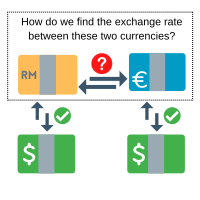
We can go one step further and look at the relative movements across the currencies. The value of the ringgit depreciated against the USD in 2026 (by 0.25% from 1 USD = 4.05 ringgit in Dec ‘25 to 1 USD = 4.06 ringgit in Oct ‘26). However, the value of the euro weakened more against the USD compared to the ringgit in the same period (by 4.7% from 1 USD = 0.85 euro in Dec ‘25 to 1 USD = 0.89 euro in Oct ‘26). This means that when we compare the ringgit against the euro, the ringgit has actually strengthened against the euro.
As a net exporting economy, we should not only compare the ringgit to the US dollar but take a broader view and compare against other currencies, in particular our major trade partners. For this, we can use an indicator called the nominal effective exchange rate (NEER). The NEER considers movements of the ringgit against a basket of currencies. The value of foreign currencies in the basket are normally weighted according to the value of trade with the domestic country. This could be export or import value, the total value of exports and imports combined or some other measure.
When the ringgit value increases against the basket of currencies, NEER is said to appreciate. When the ringgit value falls against the basket, the NEER depreciates.
Exchange Rate Policy Framework
Malaysia adopts a flexible exchange rate regime, where the value of the ringgit is determined by demand and supply in the foreign exchange market.
As a small and open economy, Malaysia is closely connected to developments in the global economy and financial markets. A flexible exchange rate allows the ringgit to adjust to changing conditions while supporting the economy's ability to respond to external developments and shocks.
This framework supports the broader objective of monetary stability by allowing monetary policy to remain focused on domestic economic conditions and the pursuit of price stability, while the ringgit adjusts to changing economic and financial developments. At the same time, a well-functioning foreign exchange market enables businesses, investors and other market participants to manage their foreign exchange needs efficiently, supporting the economy's resilience in an evolving global environment.
BNM's role in promoting price stability
Bank Negara Malaysia's primary objective is to maintain price stability while supporting sustainable economic growth.
Price stability means that changes in the overall level of prices remain low, stable and predictable over time. When prices are stable, households and businesses can make more informed decisions about spending, saving and investment. A stable price environment also supports business planning, investment and job creation, contributing to sustainable economic growth.
Conversely, large and unpredictable changes in prices can create uncertainty and affect purchasing power. High inflation can increase the cost of living and make it more difficult for households and businesses to plan ahead. Prolonged periods of falling prices can also be harmful when they reflect weak demand and economic activity. Maintaining monetary stability therefore helps create a more stable environment for economic decisions and long-term growth.
As part of this mandate, BNM assesses a wide range of domestic and global developments, including economic growth, inflation and financial conditions. Exchange rate movements are one of the factors considered because they can influence inflation, trade and broader economic conditions. However, BNM does not target a specific level of the ringgit. Instead, the exchange rate is allowed to adjust in response to economic fundamentals and market conditions.
BNM's role is not to determine the level of the ringgit.
Rather, BNM's objective is to ensure that the foreign exchange market remains orderly and continues to function effectively.
Why Malaysia adopts a flexible exchange rate
Supporting economic adjustment
In bad times, the flexible ringgit helps cushion the impact to our economy from changing global conditions, by adjusting the relative prices of our goods and services. While it will make the prices of imports more expensive, a weaker ringgit also makes our exports more competitive and domestic goods and services more attractive, as it becomes relatively cheaper. This helps to support jobs and incomes in export-oriented industries and helps prevent a sharp decline in spending by households. On the other hand, a stronger ringgit raises consumption of imported goods and services as they become relatively cheaper.
Acting as a shock absorber
With orderly financial market conditions, where there are no large and disruptive swings in the exchange rate, a flexible exchange rate serves as a shock absorber – not a shock amplifier – to the domestic economy. This helps businesses plan and undertake business and investment decisions with more certainty, which will support a more sustainable recovery.
Preserving monetary policy independence
A flexible exchange rate allows the Monetary Policy Committee to set the policy rate independently, based on Malaysia’s domestic growth and inflation outlook. If the ringgit is pegged, Malaysia will need to follow the monetary policy movements of the currency that the ringgit is pegged to.
Why doesn't Malaysia peg the ringgit?
From time to time, questions arise on whether Malaysia should adopt a fixed exchange rate or peg the ringgit to another currency.
A fixed exchange rate can provide greater certainty in the exchange rate against a particular currency. However, maintaining a fixed exchange rate involves important trade-offs.
Under a fixed exchange rate regime, monetary policy would need to focus on maintaining the peg. This would limit the flexibility to adjust monetary policy in response to Malaysia's own economic and inflation conditions.
Malaysia is a highly open economy that relies on international trade, investment and cross-border financial flows. As such, Malaysia benefits from maintaining openness to international capital flows and allowing businesses and investors to transact freely across borders.
At the same time, monetary policy needs to remain focused on domestic economic conditions so that BNM can respond appropriately to developments affecting inflation and growth in Malaysia.
This is one of the key reasons Malaysia adopts a flexible exchange rate regime today.
The Policy Trilemma
Central banks around the world have to choose between having free flow of capital, a fixed exchange rate and independent monetary policy (the three corners of the triangle in the diagram). Only two of the three options are achievable at a given time.
Side A: If the country fixes its exchange rate and allows free capital flow across its borders, it cannot have an independent monetary policy.
Side B: If a country chooses free capital flow and wants an independent monetary policy, it cannot have a fixed exchange rate.
Side C: If a country fixes its currency value and has an independent monetary policy, it cannot allow free flow of capital across its borders.
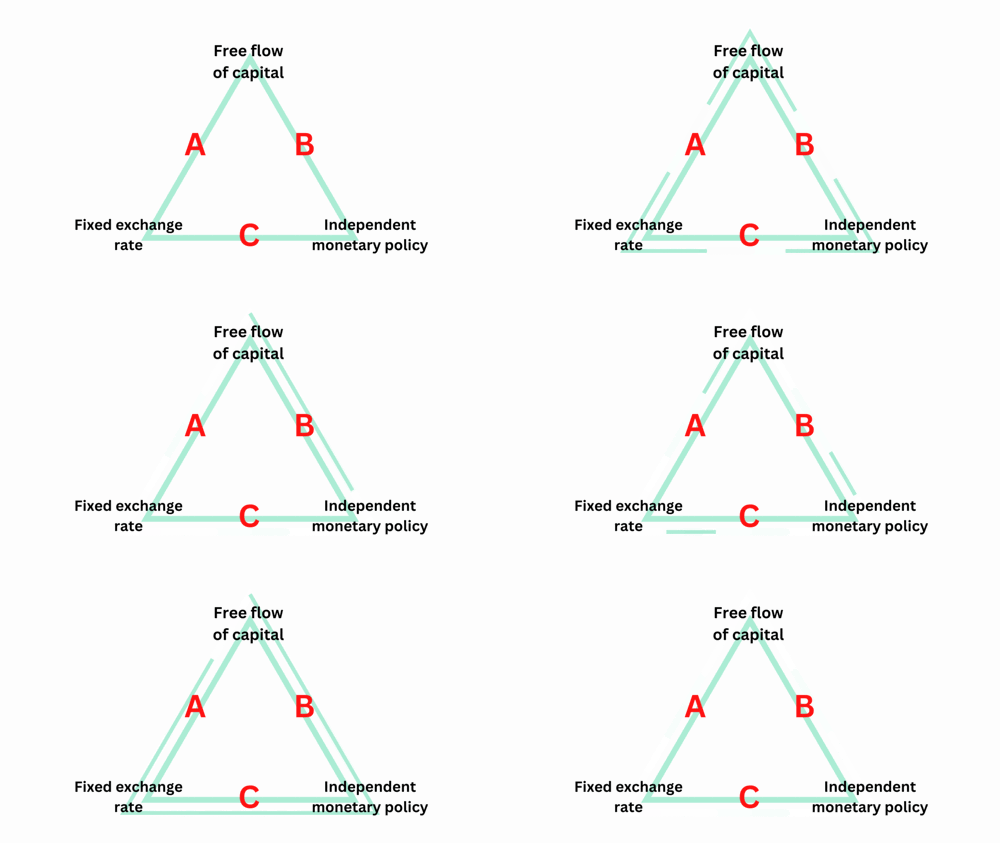
To visualize this, BNM sets monetary policy independently (i.e. taking into account Malaysia’s growth and inflation) and we allow investors to invest or withdraw money from Malaysia (Side B). Imagine a scenario where we fix our exchange rate, by pegging the ringgit to the US dollar at a rate that is lower (i.e. stronger) than the prevailing ringgit exchange rate. At the same time, given the domestic economic outlook, BNM sets the policy rate at a level that happens to be lower than the policy rate in the US. This would cause foreign capital to leave Malaysia in search of higher returns in the US. This would reduce demand for the ringgit which would eventually erode the sustainability of the exchange rate peg. On the other hand, if the domestic economic outlook requires the policy rate to be set at a level higher than in the US, it would attract capital into the country and the ringgit would strengthen. It is not possible to achieve all three sides of the triangle, which is the policy trilemma of monetary policy.
So, countries need to choose which side of the triangle they want to be on.
If Malaysia were to peg the ringgit, there would be significant trade-offs and costs involved.
Malaysia will lose independence of our monetary policy as we need to follow the monetary policy of the currency that the ringgit is pegged to. For example, if the ringgit is pegged to the US dollar, we will need to raise the OPR whenever the US Fed raises their interest rates, even though Malaysia is at a different stage of economic recovery and inflation level. In this case, Malaysia won't be able to set our own monetary policy and the people will have to bear high financing costs even though our economy has not recovered to the same level as the US economy.
In order to maintain a peg, we need a significant amount of international reserves, or capital control measures need to be imposed to prevent or counter speculative pressures on the ringgit. Selective exchange control measures were an important factor contributing to the success of the fixed exchange rate regime in 1998. However, the negative impact from these measures on investor confidence, if introduced now would be extremely costly and could affect capital flows as we have a much larger capital market now compared to 1998.
Proponents of repegging the ringgit often cite our experience during the Asian Financial Crisis. Although pegging and selective foreign exchange control measures worked for Malaysia in 1998, it is not the right solution for the challenges we face today. We are now a very different Malaysia, and our economy has come a long way since the 1990s. The Malaysian economic and financial system are in a much better position today to withstand global financial market volatility and exchange rate movements. Our external position is also strong, given our positive net external creditor position and sizable foreign currency assets that far exceed our foreign currency liabilities. Our international reserves are adequate while our banking system is also now much better capitalised. A peg will no longer work for us. What's best for us now is a floating exchange rate.
Promoting an orderly and well-functioning foreign exchange market
While the ringgit is market-determined, BNM plays an important role in supporting an orderly and well-functioning foreign exchange market.
An effective foreign exchange market helps businesses, investors and other market participants manage their foreign exchange needs and risks efficiently.
BNM's efforts are aimed at:
supporting market liquidity;
encouraging balanced two-way market participation;
promoting effective price discovery; and
mitigating excessive volatility that could disrupt economic activity.
These efforts contribute to a deeper and more resilient foreign exchange market that can continue to support Malaysia's economic and financial needs.
Was this page helpful?
Help us improve by sharing your feedback.