

Payment Services Ecosystem in Malaysia
In Malaysia, the payment services ecosystem is classified under two broad categories: large value payment and retail payment. Separately, the money services business (MSB) sector comprises three regulated business activities.
Large Value Payment | Retail Payment | ||
RENTAS Real-Time Electronic Transfer of Funds and Securities (RENTAS) System | Retail Payment Systems Approved Payment System Operators (PSO) | Retail Payment Instruments Approved Issuers of Designated Payment Instrument (DPI) | Merchant Acquiring Registered Business |
Money Service Business (Licensed Businesses) | |||
Currency Exchange | Remittance | Wholesale Currency | |
Large Value Payment
Large Value Payment System (LVPS) is a systemically important payment system which typically processes high-value and time-critical payments. The only LVPS in Malaysia is RENTAS, which stands for Real Time Electronic Transfer of Funds and Securities. It operates on a Real Time Gross Settlement (RTGS) basis. It is a critical payment system as it helps to ensure the smooth functioning of our economy, financial system and financial markets.
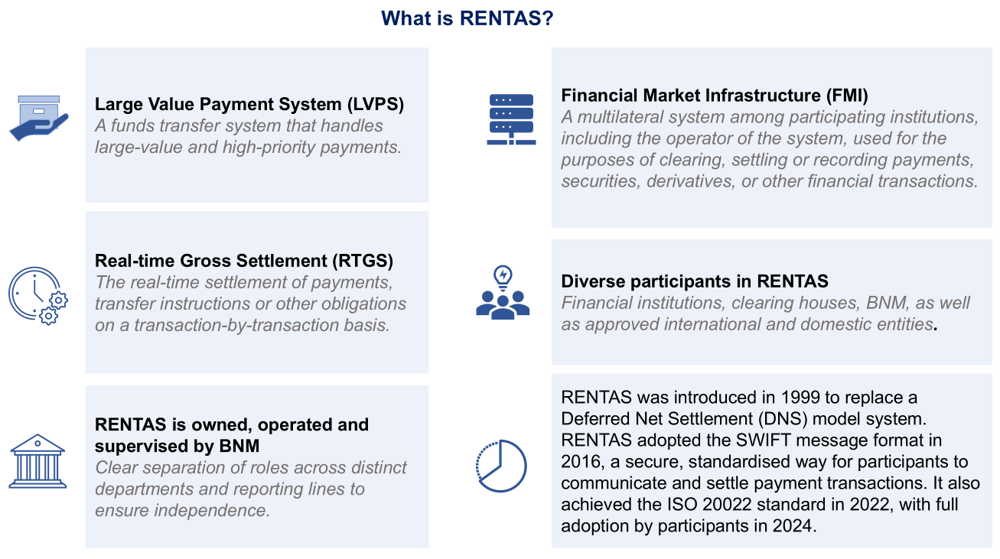
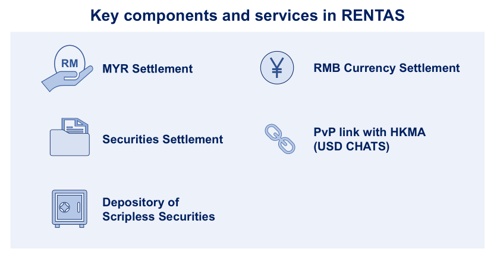
Types of transactions handled by RENTAS
Interbank Funds Transfer System (IFTS); and
Scripless Securities Transfer System (SSTS)
Transactions that can be performed by RENTAS participants
Interbank funds transfer;
Cash withdrawals from BNM;
Statutory reserve adjustment;
Money market settlement;
Ringgit leg of foreign exchange; and
Scripless securities transfer.
Payment versus Payment (PvP) link with Hong Kong’s the US dollar Clearing House Automated Transfer System (USD CHATS)
In November 2006, BNM and the Hong Kong Monetary Authority (HKMA) implemented the Payment versus Payment (PvP) infrastructure linkage between RENTAS and the US dollar Clearing House Automated Transfer System (USD CHATS). USD CHATS, operated by Hong Kong Interbank Clearing Limited (HKICL), is the RTGS system for the transfer of funds and settlement of USD in Hong Kong.
The PVP link between RENTAS and USD CHATS enables the simultaneous settlement of ringgit in Malaysia and US dollar in Hong Kong during Malaysian business hours, thus eliminating foreign exchange (FX) settlement risk for ringgit and US dollar FX transactions.
Multicurrency settlement
To enhance RENTAS' capability to support cross-border payments and settlements, an onshore multicurrency funds and securities settlement facility was launched for the Renminbi (RMB) in March 2012.
The multicurrency feature in RENTAS aims to promote the use of regional currencies for trade settlement and investment, develop the foreign exchange market in Malaysia and mitigate foreign currency settlement risk.
This feature enables RENTAS to settle participants’ RMB transactions with payment finality across the books of the appointed onshore settlement institution.
Retail Payment
In Malaysia, the retail payment ecosystem is anchored by three key players:
Operators of payment systems
Issuers of payment instruments
Merchant acquirers.
Retail payments generally involve the transfer of funds for low-value, high-volume transactions between individuals, businesses and government entities for everyday payments.
Types of approved Payment System Operators (PSO)
PSO is the operator of a system which enables the transfer of funds from one banking account to another, as defined by the Financial Services Act 2013 (FSA) and the Islamic Financial Services Act 2013 (IFSA). It includes any debit transfer, credit transfer or standing instructions but does not include the operation of a remittance system approved under section 40 of the Money Services Business Act 2011.
An example of PSO is Payments Network Malaysia Sdn Bhd (PayNet), which is the national payments network and shared central infrastructure operator.

PayNet's current service portfolio is as follows:
DuitNow* Transfer - instant account-to-account payment using mobile number, MyKad number or business registration number
DuitNow* QR - unified Quick Response (QR) code payment solution
JomPAY - payment scheme for utility bill payment
FPX - e-commerce payment
eSPICK - cheque clearing system
* DuitNow is the name of a suite of services offered under the Real-time Retail Payments Platform (RPP)
DuitNow - instant account-to-account payment across participating banks and E-wallets.
DuitNow QR – Quick Response (QR) code payment scheme, a contactless payment method.
For more information, visit the PayNet official website.
Payment instrument network operation is another type of PSO which enables payments to be made using a payment instrument. Examples of an approved payment system operator under this definition include Mastercard, Visa and Alipay+.
Retail Payment Instruments - Designated Payment Instruments (DPIs)
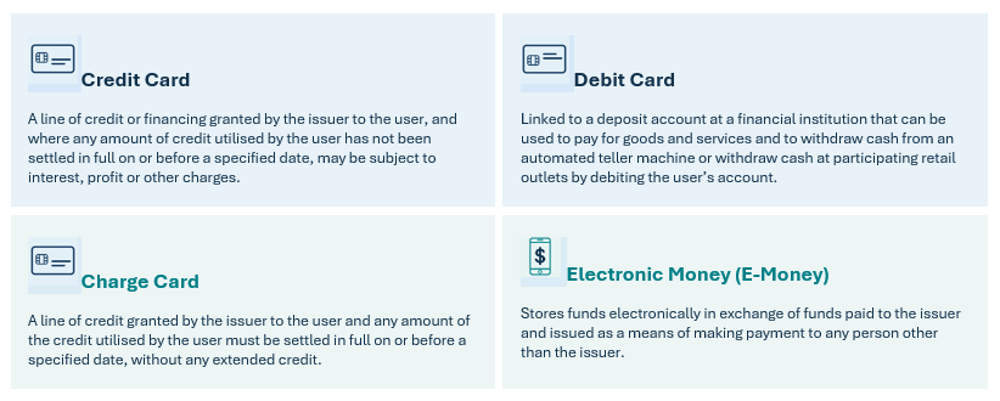
There are four types of DPI issued by both bank and non-bank issuers:
Merchant Acquiring Services
Merchant acquiring services are provided by merchant acquirers to help business merchants facilitate the acceptance of payment instruments. Merchant acquirers help business merchants accept payments from customers through tools such as point-of-sale (POS) terminals, Quick Response (QR) code, or online payment gateways. The merchant acquirers also play a key role in facilitating the movement of funds from the customer to the merchant once a payment transaction is authorised and completed.
In Malaysia, merchant acquirers that fulfil all the following criteria must register with BNM:
enters into a contract with merchant(s), which results in a transfer of funds to the merchant(s) by –
conducting or being responsible for fund settlement; or
issuing fund settlement instructions;
facilitates the merchant’s acceptance of payment instruments; and
is a direct participant of payment instrument network(s) to provide merchant acquiring services.
Other payment instruments
In addition to digital payments, cash and cheques remain widely used in Malaysia, although cheque usage is declining. These payment instruments continue to complement digital payments in supporting financial inclusion.
Cash
Malaysia continues to have a robust ATM network, with more than 15,000 ATMs nationwide.
The network of ATMs in Malaysia is supported by the Shared ATM Network (SAN) operated by PayNet, which allows customers of participating banks to withdraw cash or perform other transactions at ATMs of participating banks.
Additionally, users can also withdraw cash at agent banks and POS terminals that offer MyDebit Cash Out (MDCO). More than 3,000 agent banks and 10,000 MDCO touchpoints nationwide ensure that Malaysians, particularly the underserved community, will continue to have reliable access to cash[1].
Cheques
Cheques continue to serve as an alternative payment instrument. However, cheque usage has declined notably following a deliberate strategy by BNM to reduce cheque use.
For more information on cheque user behaviour, please refer to Page 89 of the BNM Annual Report 2024.
[1] For information, all currency notes and coins issued by BNM are legal tenders recognised by law as valid means of payment in Malaysia
Money Services Business (MSB)
The services provided by MSB operators include facilitating migrants in sending money home and enabling businesses to make trade payments (remittance business), as well as providing currency exchange (currency exchange business) to support tourism. Through these services, the MSB industry plays an integral role in supporting financial inclusion.
Types of MSB
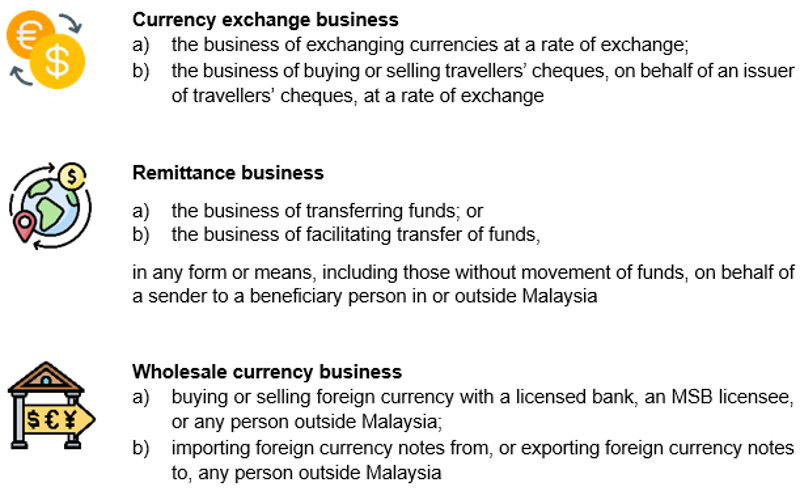
Key Features under the Money Services Business Act 2011 (MSBA)
There are four classes of licence issued under the MSBA
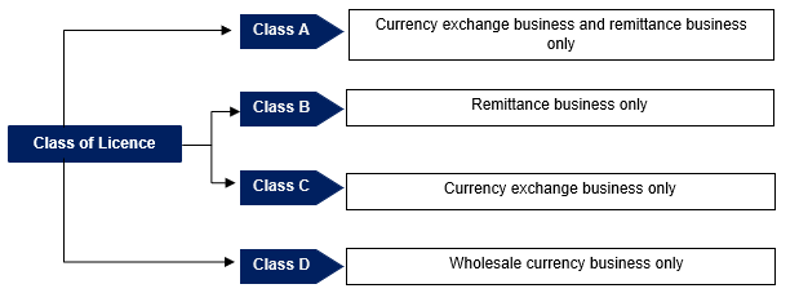
The maximum tenure of an MSB licence is 3 years, but it can be renewed.
Principal-agent model
Principals are licensed MSB companies that are approved to appoint agents to serve customers on their behalf. The agents can be MSB licensees or non-MSB licensees, such as retail stores.
Agents act on behalf of the principals using the principal’s systems and follow the principal’s Standard Operating Procedures (SOP).
Consumers should expect the same baseline standards (for example, pricing transparency, receipts, identity checks) whether they transact with an MSB principal or agent.
Was this page helpful?
Help us improve by sharing your feedback.