

iTEKAD Entrepreneurship
iTEKAD Entrepreneurship: Empowering low-income microentrepreneurs
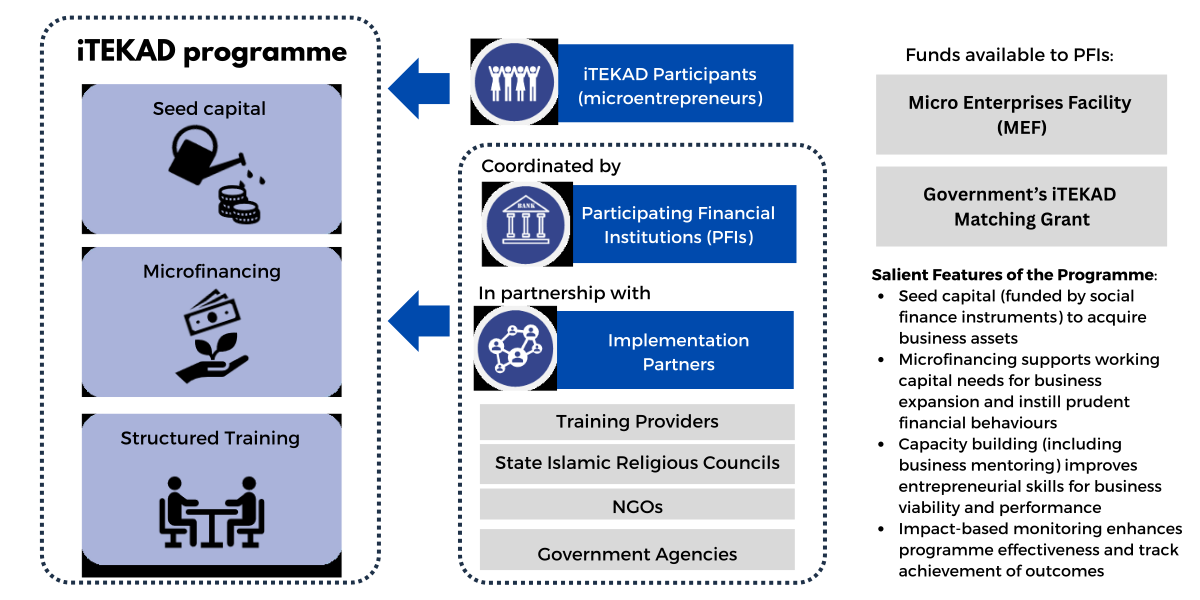
iTEKAD Entrepreneurship aims to assist low-income microentrepreneurs to strengthen their financial management and business acumen towards generating sustainable income. By leveraging on social finance instruments, each programme combines 1) seed capital to start or sustain their business; 2) access to microfinance; and 3) structured financial and business training.
For more information, please read our feature article, iTEKAD: An Ecosystem Approach in Scaling Up Social Finance in BNM’s Annual Report 2023.
Key Progress of iTEKAD (as of end-March 2026)


14,387
Total microentrepreneurs
RM94.2 million
Social finance fund disbursed
RM77.2 million
Financing and investment disbursed
Impact of iTEKAD Entrepreneurship (as at end-December 2025)
Based on sample of microentrepreneurs who graduated from the iTEKAD programme


88%
Business growth
Increased monthly sales

>2,400
Employment
New jobs created

93%
Financial resilience
Saved up to RM4,000 of business income per month on average

90%
Digital upskilling
Conduct online sales and marketing
Financial institutions participating in iTEKAD Entrepreneurship

Programme name | AEON Bank’s Growth Start Programme | Sustainable, Reliable, Income (SRI) Program |
Objective | Provide support to microentrepreneurs at early stage of their business through entrepreneurship training tailored to respective business sector | Sustainable, Reliable, Income (SRI) Program |
Funding features | AEON Bank’s Sadaqah and Ujrah, with future access to microfinancing facilities (currently being developed) | Improve the socioeconomic well‑being of B40 mothers in Selangor by equipping them with practical tailoring skills, providing essential tailoring tools, and directly linking them to income‑generating opportunities upon programme completion. |
Value-added propositions | Open-door iTEKAD programme whereby participants are provided with entrepreneurship development through funding support and training in digital marketing and operations | AEON Bank’s CSR fund and microfinancing facilities |
Target segment | B40 women entrepreneurs | Support through funding, technical skills and training in digital marketing and financial literacy. |
Implementation partners | MADCash Sdn Bhd |
|













Frequently Asked Questions on iTEKAD Entrepreneurship
1. What are the eligibility criteria for participants of iTEKAD Entrepreneurship?
At a minimum, participants must be aspiring or existing microentrepreneur from the low-income segment. Additional eligibility criteria are subject to the respective programmes implemented by participating financial institutions in collaboration with their implementation partners.
2. What examples of financing facilities do participating financial institutions offer to participants under their respective iTEKAD programmes?
Participating financial institutions can offer any microfinancing product that is suited to the needs of the target segment in their respective iTEKAD programmes. This includes products under Skim Pembiayaan Mikro (SPM) that leverage on Bank Negara Malaysia’s Fund for SMEs, particularly the Micro Enterprises Facility (MEF)
3. What aspects are typically covered under the structured training components of iTEKAD?
Broadly, this component covers three areas:
Capacity building – Participants receive training in financial and business management, as well as relevant technical know-how specific to their respective business sectors (e.g. sewing skills for tailors)
Coaching and mentoring –Participants are closely guided by a mentor / peer groups to support business growth
Value-adding support – Participants may be provided with opportunities to enhance their capabilities, such as adoption of digital technologies or by undertaking relevant certifications.
Was this page helpful?
Help us improve by sharing your feedback.