
October 2026
The conflict in the Middle East has emerged as a key source of downside risk to the global economic and financial outlook. Disruptions to commodity supplies and strategic trade routes have driven up energy, logistics and other input costs, intensified supply-side pressures, and heightened volatility in global financial markets. For Malaysia, the spillovers could be significant given the economy’s high degree of integration with global trade and financial markets.
Nevertheless, the implications for domestic financial stability have remained manageable. Loan repayment performance has remained largely sound, with pockets of pressures confined to selected business segments. Banks faced some upward pressure on funding costs, but liquidity conditions remain supported. Banks, insurers and takaful operators continue to maintain strong financial buffers that ensure uninterrupted financial intermediation, while deep domestic financial markets and a diversified investor base have helped contain the transmission of external volatility.
The effects of the conflict are transmitted primarily through indirect channels
Malaysia’s financial system has limited direct exposures to the Middle East. The principal transmission channels therefore operate through the real economy and global financial markets, rather than through direct credit or funding exposures. Higher input and logistics costs, supply disruptions and softer demand could compress business margins and weaken financial performance, while elevated inflation could erode households’ real purchasing power. These pressures could, in turn, weaken borrowers’ debt repayment capacity, while heightened uncertainty could affect consumption, saving and investment decisions. Risk-off sentiment could also prompt portfolio reallocation and capital flow volatility, affecting asset valuations, bond yields, exchange rates and market liquidity. Collectively, these effects could tighten credit and funding conditions. The impact on financial institutions could ultimately manifest in higher credit and claims costs, valuation losses, funding and liquidity pressures, and weaker earnings and capital generation.
Shocks arising from the conflict do not occur in isolation, but alongside other global economic and financial developments. Their implications for domestic financial stability depend on how these combined shocks interact with existing vulnerabilities. Evidence so far indicates that the risk of such interactions amplifying financial stress has remained limited, with the financial system absorbing the shocks with a high degree of resilience.
Financial conditions among businesses remain broadly stable, although resilience varies across sectors and firm sizes
Business conditions remain stable, underpinned by sustained domestic demand, robust electrical and electronics exports and continued investment activities. Nonetheless, engagements with businesses indicate that some firms are contending with higher input and logistics costs, delayed payments and longer cash conversion cycles. These challenges are more prevalent among small and medium-sized enterprises (SME), which tend to have thinner margins, smaller liquidity buffers and less scope than larger firms to diversify suppliers or absorb cost increases. The effects have been particularly visible in wholesale and retail trade, construction, and selected manufacturing segments. Some firms in these sectors have experienced declining cash buffers and increased reliance on short-term and working-capital financing. In primary manufacturing, higher prices for inputs such as fertilizer and petrochemical-related commodities have added to cost pressures. Most firms have nevertheless continued to secure essential supplies, albeit at higher prices.
Businesses have also taken steps to mitigate these pressures. These include improving cost efficiency, diversifying suppliers and sourcing arrangements, adjusting production and inventory plans, and strengthening cash flow management. Such adjustments have so far helped contain the impact on firms’ financial positions and preserve their ability to service their debt obligations.
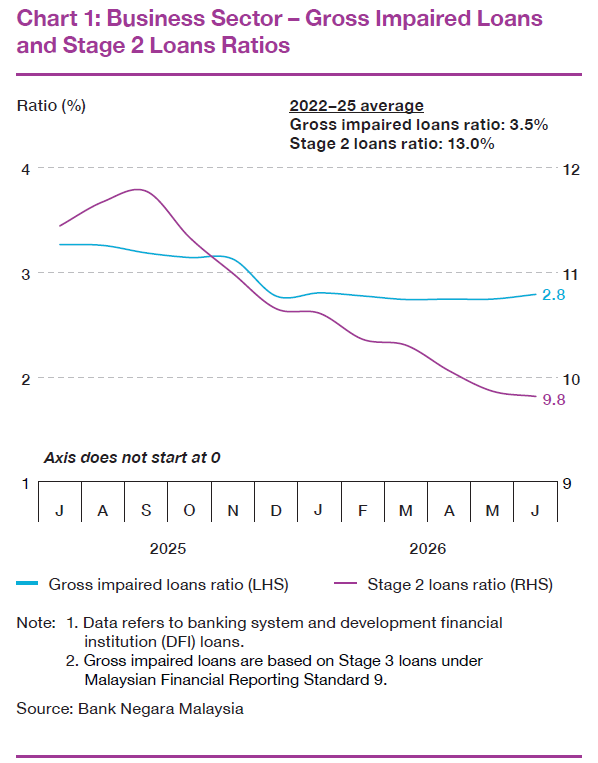
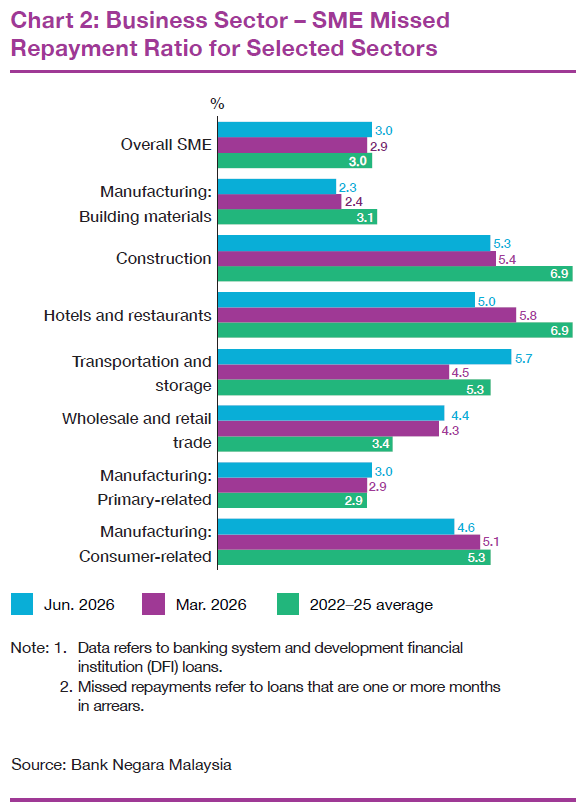
The overall quality of business borrowings remained sound. As at June 2026, the business loan impairment ratio stood at 2.8%, while the share of loans classified as having increased credit risk (Stage 2 loans) remained below its near-term average (Chart 1). Repayment pressure has nonetheless emerged in selected segments, including SMEs in the transportation, wholesale and retail trade, and primary manufacturing sectors (Chart 2). These developments point to the possibility of latent credit risk building up among selected firms experiencing persistent liquidity pressure. Continued monitoring at the borrower and sector levels therefore remains important.
Credit conditions continue to support viable businesses
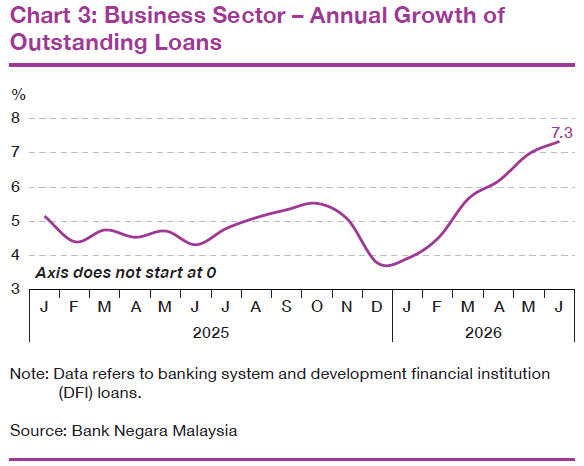
Outstanding business loans grew by 7.3% annually in June 2026, compared with average growth of 4.1% between 2022 and 2025, supported by working capital financing (Chart 3). Amid expectations that the conflict could persist, banks have exercised greater prudence in assessing borrowers in affected sectors and have maintained disciplined underwriting and risk-taking practices. These actions reflect a recalibration of risk assessments rather than broad-based credit tightening. Banks have also continued to engage borrowers proactively and provide targeted assistance to those facing temporary financial difficulties. Complementing these efforts, the Credit Counselling and Debt Management Agency (AKPK) programmes and BNM’s SME Stabilisation Relief Facility have helped support debt repayment capacity and access to financing for affected businesses. Maintaining a balance between supporting viable businesses and managing credit risks is important. The continued expansion of business and working capital financing indicates that credit intermediation remains intact, even as banks adjust their risk assessments in response to heightened uncertainty.
Household balance sheets remain broadly sound
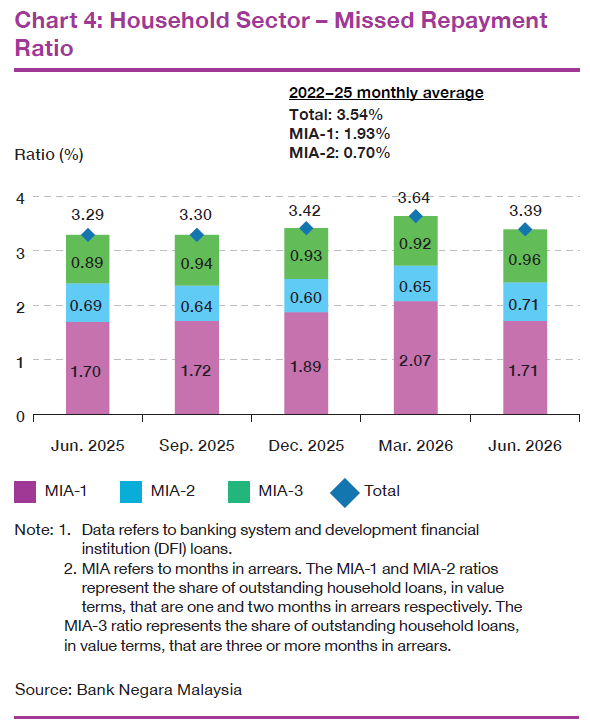
The financial position of households has remained generally resilient, supported by stable labour market conditions. Domestic policy measures such as expanded government cash assistance and continued fuel subsidies have also helped contain the pass-through of higher global costs to domestic consumer prices, thereby limiting the impact on household purchasing power and debt repayment capacity. The quality of household borrowings has remained largely stable. Looking at months-in-arrears (MIA) indicators, the MIA 2 and MIA 3 ratios, which indicate deeper repayment stress, increased marginally, while the MIA 1 ratio moderated significantly over the same period (Chart 4). This suggests that there has been no broad-based increase in new repayment difficulties among households. The increase in the MIA 2 and MIA 3 ratios was observed across all income groups, but was more pronounced amongst lower-income borrowers, who generally have more limited buffers. Demand for repayment assistance has also remained broadly stable, with exposures under banks’ repayment assistance and AKPK’s Debt Management Programme accounting for 1.8% of total banking system and development financial institutions loans (March 2026: 1.8%). Collectively, these indicators provide limited evidence that the onset of the Middle East conflict has materially affected the household sector’s debt repayment capacity.
Looking ahead, micro-level indicators suggest that most household borrowers are well placed to weather potential shocks. As at June 2026, the median debt service ratio stood at 32.1% (March 2026: 32.2%), while the median debt-to-income ratio, a measure of borrower leverage, remained stable at 1.28 times of gross income (March 2026: 1.29 times).
Domestic financial markets remain orderly amid external volatility2
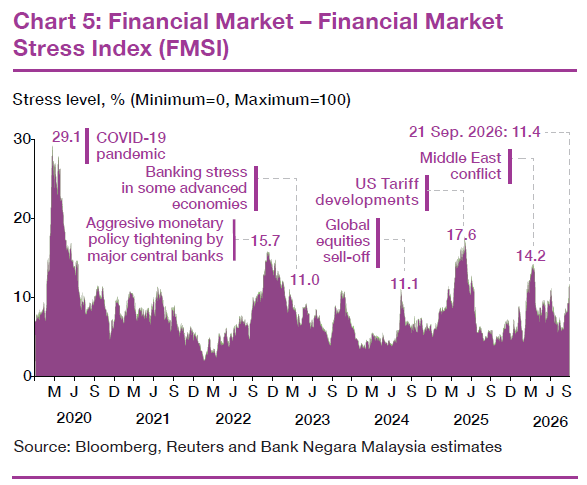
Heightened geopolitical tensions and evolving expectations for US monetary policy have contributed to shifts in global risk sentiment and continued volatility across financial markets. These developments prompted portfolio rebalancing by non-resident investors across emerging markets, including Malaysia. Non-resident investor positioning was also affected by index-related rebalancing in the Malaysian equity market. Consistent with the more volatile external environment, the Financial Market Stress Index averaged 9%, above its 2021 to 2025 average of 7.4%. The index declined from a peak of 14.2% recorded before the agreement on a two-week ceasefire between the US and Iran in April 2026, but subsequently remained elevated amid continued geopolitical uncertainty and, more recently, higher bond yields in advanced economies (Chart 5). Domestic financial markets have nevertheless continued to absorb these external developments and function in an orderly manner. The onshore foreign exchange market remained healthy, supported by balanced two-way flows, with average daily foreign exchange turnover of USD21.9 billion. The ringgit depreciated by 0.43% against the US dollar on a year-to-date basis, although Malaysia’s strong economic fundamentals continue to provide enduring support amid broader US dollar movements.
Yields on Malaysian government bonds moved higher alongside developments in global bond yields. Despite portfolio adjustments, non-resident holdings of government securities increased by RM8.1 billion on a year-to-date basis. Widening yield differentials between the Malaysian Government Securities and US Treasury and sizeable government bond maturities could increase the sensitivity of portfolio flows to external developments. Nonetheless, Malaysia’s deep financial markets and diversified investor base, together with resilient domestic financial institutions, will continue to underpin orderly market conditions.
Financial institutions remain resilient, supported by strong financial buffers
Banks remain well positioned to absorb the effects of adverse economic and financial conditions. The total capital ratio stood at 17.9% of risk-weighted assets, comfortably above regulatory requirements. This resilience was further supported by healthy profitability, with return on equity and return on assets standing at 11.5% and 1.3% respectively. Credit risk remained contained, with the aggregate impairment ratio holding steady at 1.4% (March 2026: 1.4%) and the share of Stage 2 loans declining to 5.9% (March 2026: 6.1%). Banks also maintained prudent provisions, with the loan loss coverage ratio (including regulatory reserves) standing at 124.6%.
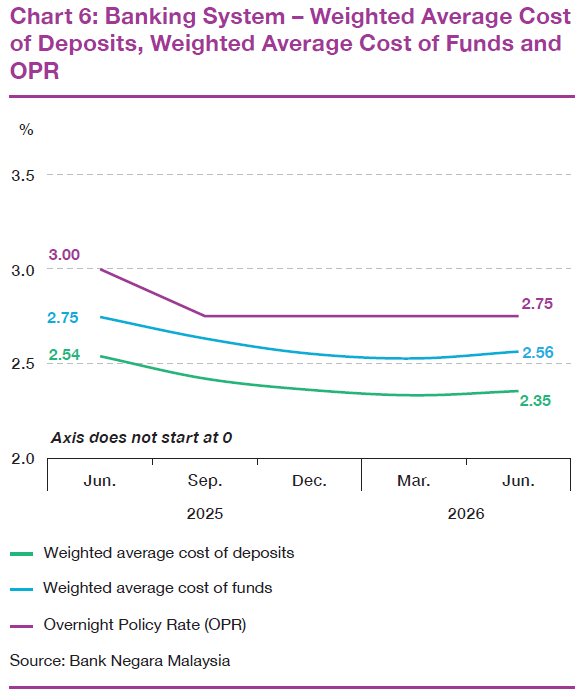
Liquidity and funding positions similarly remained resilient. The aggregate Liquidity Coverage Ratio and Net Stable Funding Ratio stood at 149.6% and 114.7% respectively, well above the regulatory minima. Total banking system liquidity remained sufficient, supported by Bank Negara Malaysia’s liquidity operations, and continued to provide banks with meaningful buffers against potential funding and liquidity shocks. The cost of funding for some instruments have gradually increased, partly reflecting stronger competition for deposits. This has exerted some upward pressure on banks’ funding costs (Chart 6), although the magnitude of the increase varied across funding instruments. However, these developments have not translated into broader funding stress or constraints on banks’ capacity to support credit intermediation. External funding conditions also remained favourable, with access to foreign currency funding continuing to be supported by well-functioning markets.
Insurers and takaful operators remain resilient, supported by strong capital positions. As at June 2026, the sector’s aggregate capital adequacy ratio stood at 225%, well above the regulatory minimum. Claims experience remained broadly stable, while healthy new business growth, low surrender payouts and favourable investment performance continued to support profitability. Direct business exposures to conflict-affected regions were limited and largely concentrated in the marine, aviation and transit-related segments, accounting for only 0.4% of total gross premiums. The continued availability of reinsurance support further mitigated the risks from these exposures. However, a prolonged conflict could affect claims volatility through higher repair, replacement, transportation and reinsurance expenses. Weaker household and business cash flows could also affect existing policyholders’ ability to maintain their insurance policies and reduce demand for new coverage. Nevertheless, these effects have not materialised to date.
Financial stability risks remain manageable, but vigilance is warranted amid continued uncertainty
The Middle East conflict remains a material source of uncertainty. A further escalation or a more prolonged conflict could result in larger commodity price shocks, persistent supply disruptions and weaker global growth. Volatility in global financial markets could also remain elevated as investors reassess geopolitical developments, commodity price prospects and the path of interest rates in major economies.
Nevertheless, evidence to date indicates that the risks to domestic financial stability remain manageable. Financial pressures have been confined to certain sectors and borrower segments, while aggregate credit quality remains sound. Financing continues to flow to the real economy, and financial institutions retain strong capital, liquidity and provisioning buffers. The macro stress tests conducted by BNM earlier in the year remain relevant, as the scenarios captured heightened global risk aversion arising from geopolitical developments, as well as inflationary pressures from supply chain disruptions and rising commodity prices. The potential effects of a prolonged or more severe conflict are expected to remain within the range of outcomes considered in these scenarios, under which the financial system continues to demonstrate resilience even under more adverse conditions.
While the Malaysia’s financial system has demonstrated resilience, it is not immune to further shocks. Thus, BNM remains vigilant with continued surveillance focusing on business liquidity, repayment trends among vulnerable firms and households, bank funding conditions and the potential for shocks to be amplified through financial markets.
Notes
[1] Since 1 July 2026, BNM has enhanced the reporting in CCRIS to ensure that viable borrowers facing temporary financial difficulties due to events beyond their control (such as natural disasters, pandemic, and geopolitical disruptions) are not adversely affected when availing themselves of targeted repayment assistance.
[2] Data on financial markets are assessed from 1 March to 21 September 2026, unless stated otherwise.
[3] Refer to the section on ‘Assessing the Resilience of Financial Institutions’ of the 2H 2025 Financial Stability Review for further details on the stress test exercise.
CSS
