
First Published in Economic & Monetary Review 2022
Introduction
Insufficient retirement savings is a critical issue around the world. It is expected to worsen in the future. The World Economic Forum (WEF) projects that global pension savings will face a shortfall of USD400 trillion by 2050.[1] This is mainly due to longer life expectancies and higher dependency ratios.[2] While longer life expectancies are a positive trend, a shrinking working age population adds a strain on prevailing social protection systems. Thus, individuals entering retirement may find it harder to meet their post-retirement needs.
Malaysia is also confronted with these global trends. In addition, income levels in Malaysia remain low (BNM, 2018) while household indebtedness[3] is relatively high. These factors dampened the saving capacity of Malaysians. This is further aggravated by the significant informal sector in Malaysia (DOSM, 2020) as informal workers have limited access to the current social protection framework that mainly serves the formal employment sector.[4] Furthermore, with numerous special withdrawals of retirement savings during the COVID-19 pandemic, many have prematurely eroded their old-age savings, with long-term implications on their standard of living especially amidst increasing life expectancies. Large withdrawals were made particularly by younger individuals within the age group of 26 to 40 years old. Between 2020 and 2022, the share of members in this age group who met the Employees Provident Fund’s (EPF) definition of Basic Savings[5] declined the most (Chart 1). The median withdrawal amount for this age group amounted to RM16,400. This implied foregone savings ranging from RM24,000 to RM94,000[6] or equivalent to 10% to 39% of current Basic Savings when they retire at the age of 60.[7]
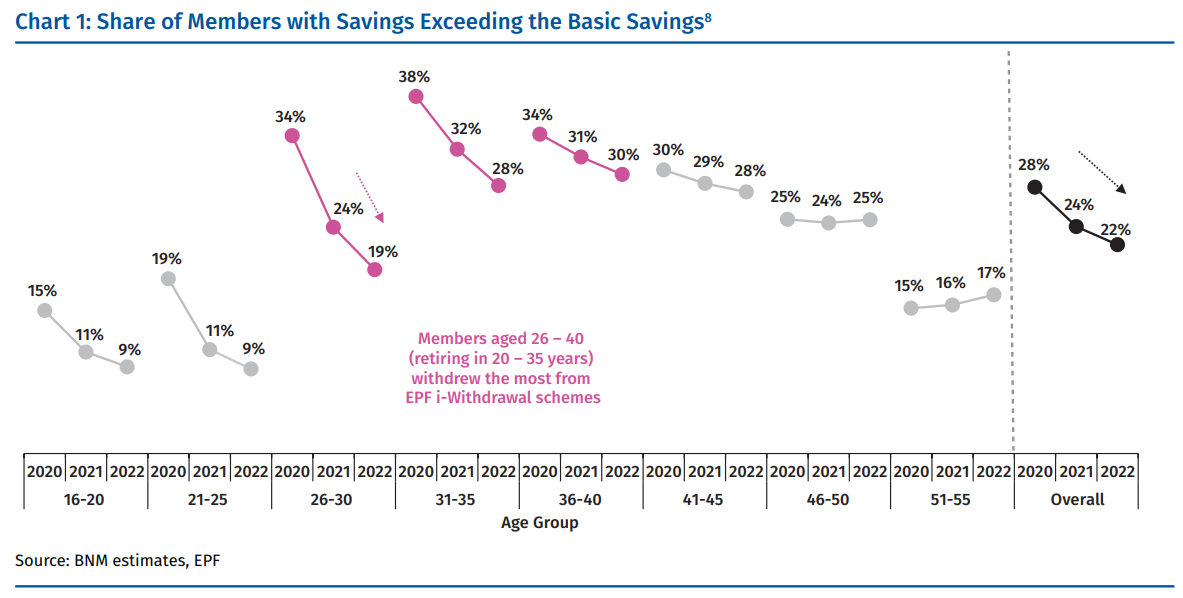
The unprecedented scale and impact of the COVID-19 pandemic have stretched the limits of the current social protection systems in many countries, including Malaysia, necessitating ad-hoc fiscal support to supplement them. This underscores the urgent need for critical policy interventions to ensure Malaysians will be protected adequately during retirement age without overburdening fiscal coffers or significantly increasing personal contribution rates at the expense of current disposable incomes. This article focuses on the need to rebuild retirement savings as part of the social insurance and overall social protection system.[9] It also examines the current state of the Malaysian retirement saving framework and discusses several shorter-term priorities that can help advance the design of a more effective social insurance system for Malaysia.
This article mainly deals with retirement savings under a defined contribution scheme, which is what most Malaysian workers rely on (e.g., EPF contribution scheme). Defined contribution schemes specify what employers and employees must contribute to the employee’s individual retirement savings account. This contrasts with defi ned benefit schemes (e.g., Skim Pencen Penjawat Awam), which specify the amount of retirement pension an employee will receive, based on average or final attained salaries, with employers fully financing the pension payments. In Malaysia, the issues faced by those under the defined contribution scheme are unique and were exacerbated during the pandemic. Although defined benefit schemes face their own set of risks and issues such as insufficiency of monthly pensions and fiscal sustainability, these issues deserve their own separate analysis.
Global Landscape of Retirement Savings Systems
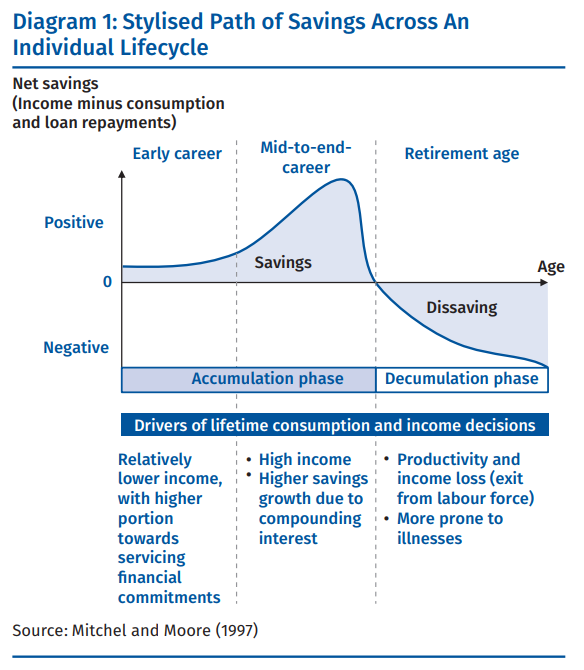
Conceptually, an individual’s retirement savings lifecycle can be divided into the accumulation and decumulation phases (Mitchel & Moore, 1997). During an individual’s working age (the accumulation stage), income typically exceeds consumption allowing for a net positive accrual of savings (Diagram 1). As the individual retires or exits the labour force, decumulation of savings would be necessary given the lack of income relative to consumption. However, during an individual’s working years, they may be subject to various predicaments such as unemployment, health, and disability risks that affect the accumulation of savings. Upon retirement, health and disability risks persist, while longer lifespans heighten the exposure of the elderly to the risk of insufficient savings. Participation in a social insurance mechanism mitigates these risks in both the working and post-retirement years. For example, unemployment insurance programmes provide income replacement for participants who lost their jobs, reducing the need to tap into their savings in the event of a shock.
The setup of a country’s pension system plays a significant role in ensuring sufficient savings accumulation during working age for use upon retirement. Globally, countries have adopted pension systems that vary in their design, though they can be clustered into four main types namely the proprietary, modified, post-colonial, and modern systems. These systems differ in their coverage, contributory arrangement, and funding (Table 1).
The proprietary system provides extensive government-financed assistance to the old-age population through a pay-as-you-go (PAYG) pension system with a wide coverage of the labour force, thus requiring significant fiscal outlay. PAYG, which relies on tax revenue from current workers to finance pensions for the old-age population at a point in time, is a key feature of the long-standing pension framework in Germany and France. The modified system was introduced to reduce the reliance on fiscal coffers to finance the pension system, forming the basis of the US and UK pension systems. Government-financed pensions in this system are typically intended to provide a minimum level of protection financed primarily via a general payroll or social security tax. Within this system, private pension schemes play a significant role in the accumulation of retirement savings, whereby the government sets up the legal landscape (e.g. mandatory enrolment requirement) and introduces incentives (e.g. matching contribution). These lower the barriers towards achieving sufficient retirement savings for individuals, particularly those of lower income.[10]
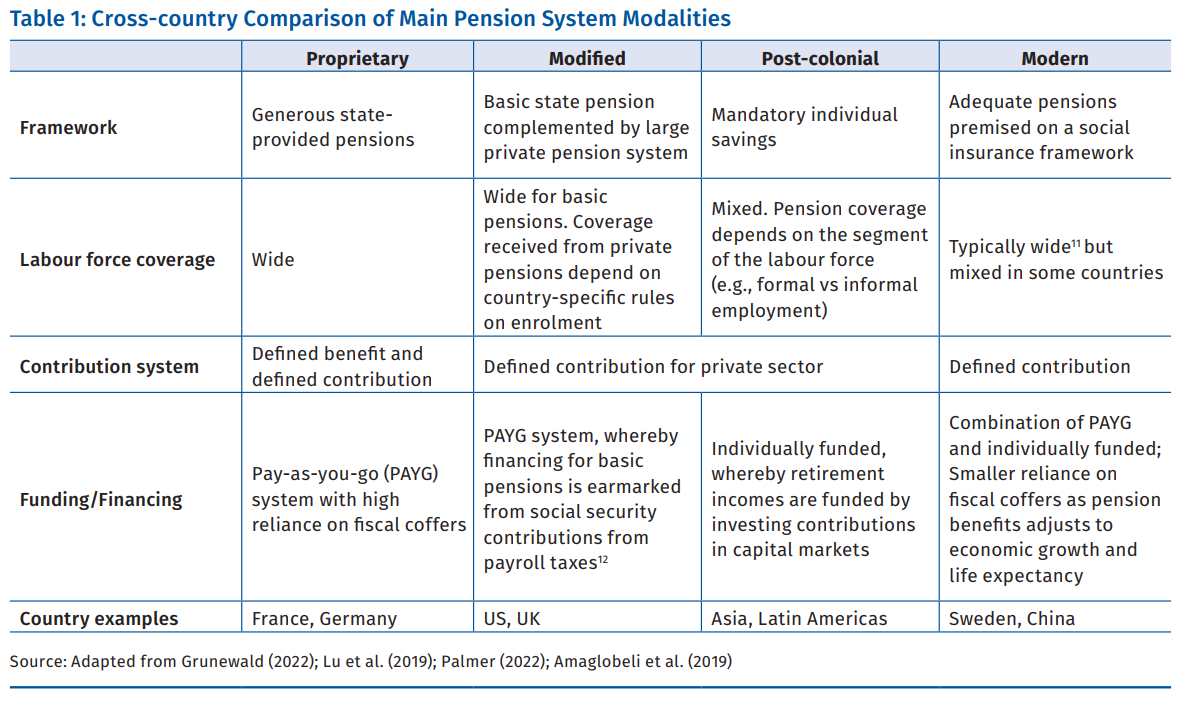
Contrary to the first two systems that are reliant on government financing, the post-colonial system is designed such that the government, individuals and employers have a shared responsibility in building retirement savings. This system institutes mandatory individual savings, typically managed by provident funds, such as in Singapore and Malaysia, with a role of growing the savings through strategic investments. Finally, the modern systems combines features of PAYG and individual contributions, making it more actuarially complex. Higher contribution rates are typically required and pension benefits are linked to economic growth and life expectancy (International Federation of Pension Funds Administrators, 2021). It is a relatively new system which retains the universality of pensions under the proprietary system, but offers greater sustainability. However, the reliance on actuarial complexity means that it is currently practised in only a few countries namely Sweden and China.
For private sector workers, Malaysia’s existing pension system is more closely aligned to the post-colonial system. Primarily, these workers fall under a defi ned contribution scheme (i.e., EPF retirement savings). Compared to a universal basic pension that uses government financing to ensure coverage for every citizen, the post-colonial system adopted by Malaysia reduces fiscal cost by distributing responsibility among employees, employers, and the government.[13] However, its coverage of a minimum level of social protection would not be as extensive as a universal basic pension. Against this backdrop, private sector workers are therefore more vulnerable due to insufficient retirement savings accumulation.
Assessing Malaysia’s Current Retirement Saving Framework Within the Wider Pension System
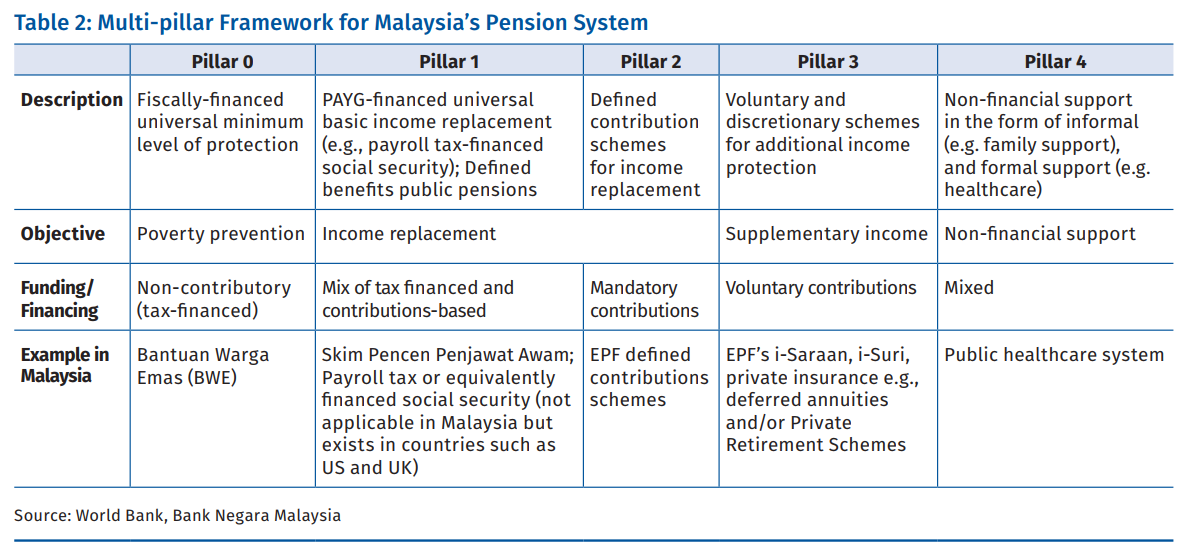
The effectiveness of a pension system can be assessed in terms of both its breadth and depth. Firstly, breadth assesses the extent to which a pension system provides different forms of support for the elderly. This is important as vulnerabilities at old-age and the corresponding policy intervention needed may vary from one person to another. For example, if the pension framework is solely based on drawing down savings through contributory schemes, low income and informal sector workers would be at greater risk of falling into poverty upon retirement. Additional layers of support are necessary to cater for the wide-ranging needs of the old-age population. Hence, the assessment of breadth is often guided by the World Bank’s multi-pillar pension system framework, comprising fi ve forms of intervention, each with distinct but complementary objectives. (Table 2).
The first pillar is Pillar 0 which provides a basic level of old-age income security to elderly individuals, typically with the objective of alleviating poverty. This is often financed fully by fiscal coffers and disbursed through government transfers (e.g., cash handouts). Therefore, for Pillar 0 policies, fiscal sustainability is an important policy design consideration in terms of assistance amount and eligibility. In the earlier example, a sufficient Pillar 0 would ensure low-income and informal sector workers would have a safety net to land on should they have insufficient retirement savings. Pillar 1 policies go further than Pillar 0 policies as they provide a basic income replacement for the elderly. These are often financed on a PAYG basis, meaning that current workers’ contributions finance current retirees’ pensions. An example of a Pillar 1 policy is the ‘State Pension’ provided in the United Kingdom. This pension is financed by National Insurance contributions from current workers and disbursements are based on an individual’s past contributions. Pensions for civil servants in Malaysia, which is a form of defined benefit scheme, are typically classified under Pillar 1 (i.e., Skim Pencen Sektor Awam in Malaysia). While also acting as an income replacement mechanism, Pillar 2 policies are, however, funded by an individual’s own income-linked mandatory contributions. These contributions are invested either by the government or through a provident fund, where withdrawals can be made at a specified age (e.g., age 55 for EPF savings in Malaysia). Next, Pillar 3 describes policies with voluntary participation which aim to provide supplementary income to the elderly beyond the level of protection accorded by Pillars 1 and 2. Additionally, Pillar 3 policies also provide an alternative savings avenue for individuals that are excluded from the mandatory setting of Pillar 2, such as informal workers. Due to their discretionary nature, there are a wide range of schemes and funds available for contributors based on their saving goals and risk tolerance. Finally, Pillar 4 covers a wide range of non-financial support mechanisms. These include formal support, such as healthcare, and informal support, such as family support.
Different countries balance the five pillars differently depending on the pre-existing pension systems. In Malaysia, there is generally a greater reliance on retirement saving (Pillar 2) given the prominence of the post colonial pension system for private sector workers’ pensions.
Secondly, depth refers to whether a pension system’s pillars and policies achieve the desired characteristics of effectiveness. This is measured against three key characteristics: (1) adequacy, (2) sustainability, as well as (3) equitability.
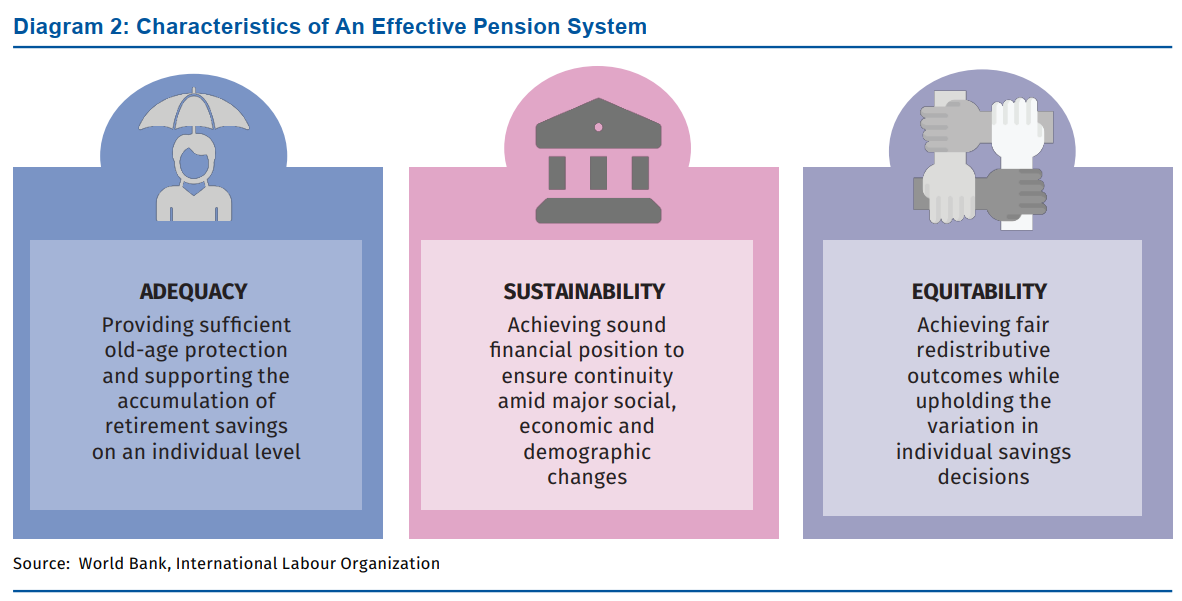
Malaysia’s pension system exhibits different levels of adequacy across the pillars. Currently, Pillar 0, which acts as a minimum pension benchmark for private sector workers in Malaysia, is inadequate. For instance, Pillar 0 assistance provided by the Social Welfare Department through the Bantuan Warga Emas (BWE) falls below minimum acceptable standard of living levels.[14] As a result of the low adequacy for Pillar 0 as well as the absence of Pillar 1 protection, private-sector retirees are at risk of a wide range of vulnerabilities if their mandated Pillar 2 retirement savings are insufficient to sustain their post-retirement living costs. This is amid the multiple special withdrawal facilities during the COVID-19 pandemic, which have reduced adequacy of Pillar 2 savings for many.15 Additionally, due to the limited affordability and accessibility of private retirement schemes16 under Pillar 3, most Malaysians are not able to access additional income protection. To some extent, Pillar 4 policies provide some support given the accessibility of universal public healthcare which mitigate health risks for the old-age population. According to the World Health Organization (WHO), Malaysia received a score of 73 in the 2017 universal health coverage service coverage index (SCI), comparable to countries such as Finland (78), France (78), and Turkey (74).17 While this is subject to risks such as high financing needs, this pillar is relatively adequate compared to other pillars.
Sustainability of the Malaysian private pension system is generally sufficient. However, this is partly attributed to the lower adequacy for Pillar 0 as mentioned above. Currently, programmes like Bantuan Warga Emas takes up a relatively small share of the Government’s revenue at 0.3%.18 Sustainability is also supported by the better implementation of Pillar 2 as EPF’s strong institutional capacity has resulted in a historically robust performance, even during periods of economic downturn. Going forward, voluntary retirement saving (Pillar 3) policies could be an area of focus to reduce reliance on Pillar 2. The success of Pillar 3 would rely on complementary measures to boost incomes and strengthen financial literacy for Malaysians to inculcate the habit of discretionary savings.
Equitability is generally low in Malaysia’s private pension system due to the gaps in coverage. While workers currently in the formal sector are provided with more equitable protections (e.g., employment insurance) and access to Pillar 2 schemes, the increasing share of informal workers in Malaysia19 warrants several critical and urgent policy interventions. Currently, the coverage of Pillar 2 schemes is mostly confined to employees with a formal employer-employee relationship, making informal sector workers (e.g., self-employed individuals) highly vulnerable to lifecycle risks. This is compounded by the high degree of fragmentation in cash assistance programmes, which results in exclusion errors. In general, greater provisioning of the social protection floor[20] would ensure a more equitable pension system. This could be achieved by sustainably enhancing Pillar 0 policies. Besides increasing the amounts disbursed under Pillar 0, greater effectiveness can also be achieved by embedding elements of upward mobility that enhances one’s income-earning capacity into the policy design. For example, cash transfer programmes such as the Sumbangan Tunai Rahmah[21] can be linked to other pillars of social protection,[22] such as active labour market policies (ALMPs),[23] to encourage upward mobility, enhance the beneficiaries’ ability to earn higher income, and in the long-term promote greater capacity for accumulation of retirement savings.
Saving Our Tomorrow: Reforms for A Better Future
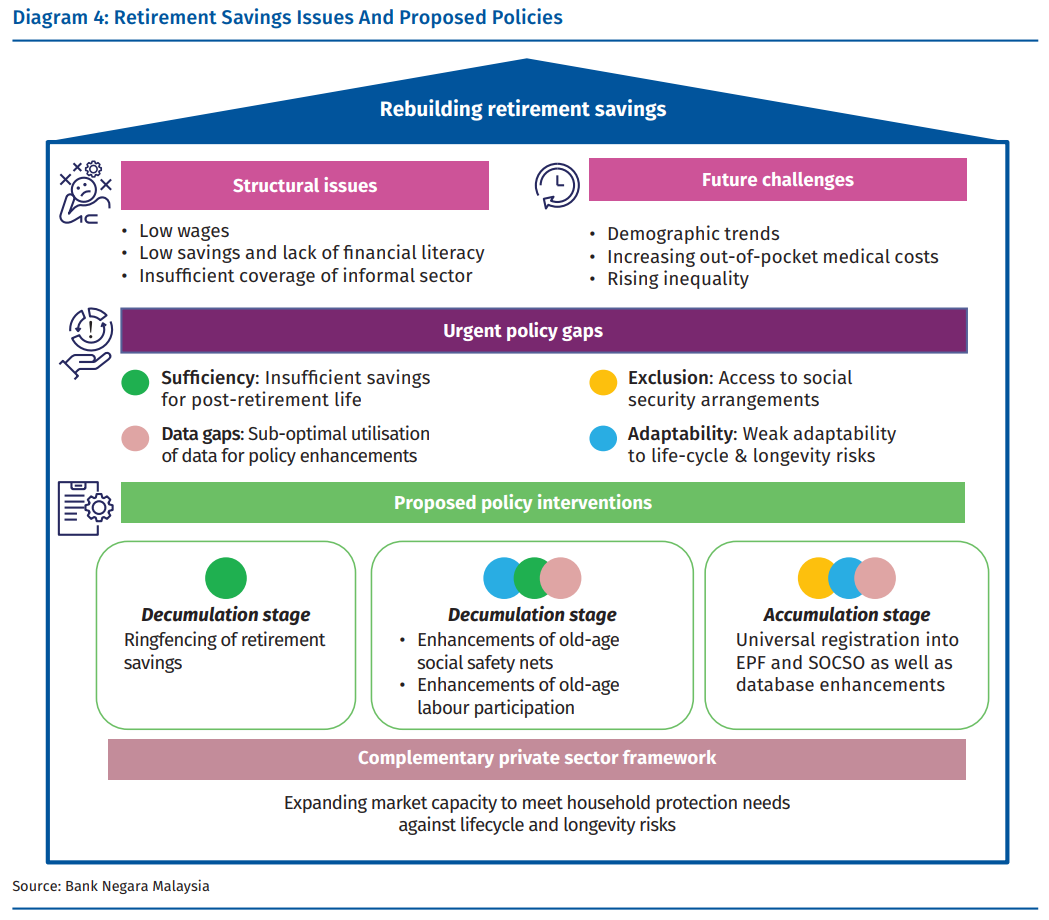
Addressing issues related to retirement savings in Malaysia will take a larger timeframe as most of the impediments, such as low wages, are structural in nature. Of importance, as advocated by several multilateral agencies,[24] policy reforms are most effective when they are comprehensive, complementary to each other and linked with multiple pillars of social protection. In terms of sequencing, equitability-focused reforms can be the focus in the medium term, where immediate priorities should be centred on rebuilding resilience and adequacy of retirement savings in a post-pandemic landscape. The latter includes ringfencing of retirement funds and enhancements to existing old-age safety net programmes. This should be done in tandem with system enhancements to improve broader policy effectiveness and efficiency, such as enhancing productivity and unlocking the potential of social protection data. These immediate priorities will be the primary focus of this section.
Ringfencing of retirement funds to lengthen the accumulation stage in ensuring adequate savings
The risk of inadequate pensions, which is already acute, has been further exacerbated by the recent massive pre-retirement withdrawals of savings. In Malaysia, the pre-pandemic median savings for the cohort between the age group of 51 and 55 would only have lasted an additional 5 years[25] upon withdrawal at 55. However, following the pre-retirement withdrawals of savings since the pandemic, it has further been reduced to around 3 years. To put this into perspective, the average global life expectancies are expected to rise to above 77 by 2050 (United Nations, 2022). Based on this, an average Malaysian would be at risk of having depleted his or her retirement savings 19 years before death. This sizeable gap between the median longevity of retirement savings and life expectancy after retirement highlights the urgent need to rebuild savings buffers.
The sizeable gap between the median longevity of retirement savings and life expectancy after retirement highlights the urgent need to rebuild saving buffers, depleted by special withdrawals during the pandemic
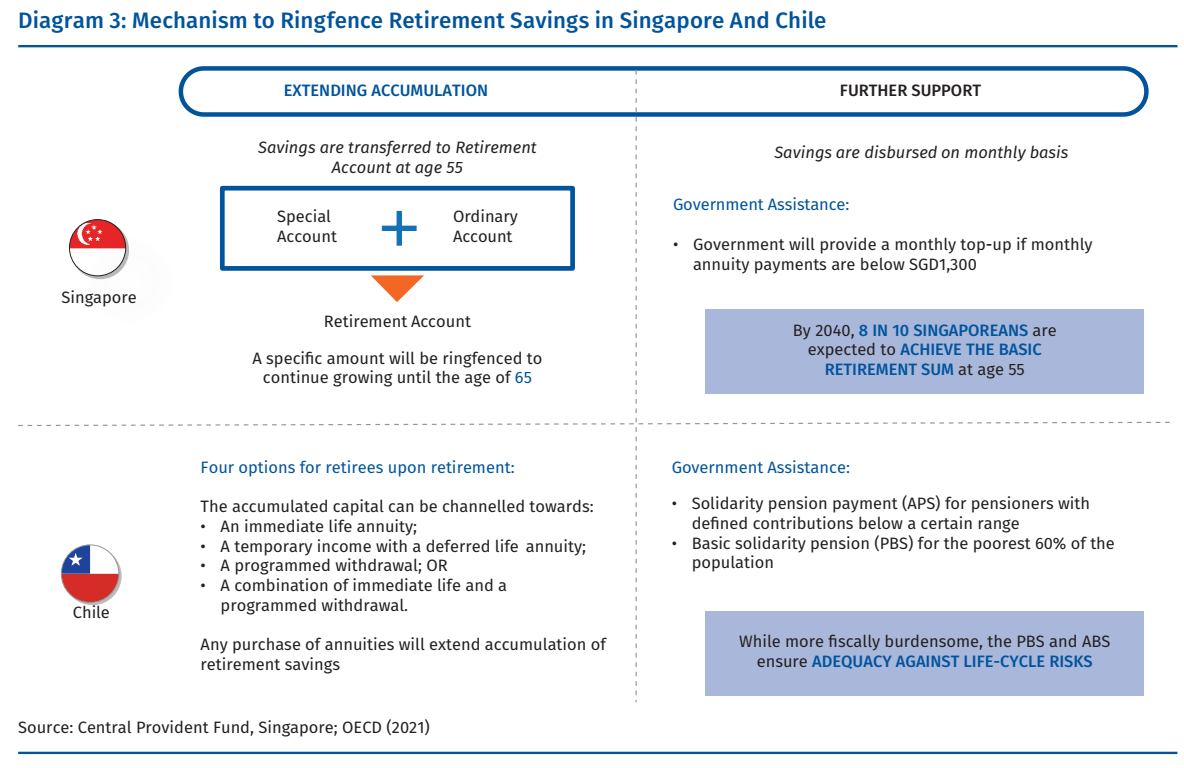
Against this backdrop, policies to enhance savings accumulation by way of lengthening the accumulation phase needs to be urgently instituted. Based on international benchmarking, ringfencing and reinvestment offers a potential solution. This involves reinvesting a portion of savings that would otherwise have been withdrawn upon the withdrawal age, thereby extending the accumulation period.[26] For example, in Singapore, a portion of an individual’s savings[27] at age of 55 are transferred to their retirement savings account, allowing it to grow for a further 10 years. In Chile, retirees are given an option to fully or partially annuitise their accumulated savings, allowing some level of continued capital growth in contrast to a lump-sum withdrawal. Both countries found success in reducing longevity risk[28] (Diagram 3). In Malaysia, the benefit of ringfencing will be significant, specifically for members with continuous contributions after reaching the withdrawal age at 55 years old. EPF members aged 50 to 54 years old with incomes at the B40 threshold stand to benefit up to an additional RM36,800[29] more savings if they defer withdrawals of savings and continue contributing by another 5 years to age 60. This is equivalent to 16% of EPF’s Basic Savings and could extend the sufficiency of accumulated savings post-retirement by an additional 3 years. This will unequivocally improve the resilience against economic and financial shocks for retirees. Enhancing savings sufficiency could also be achieved by increasing contribution rates. However, this may be more challenging as it could be impeded by structural factors such as low wages, or lead to unintended consequences such as disincentivising hiring of new workers. This policy could be explored in the future alongside income-enhancing policies and incentives for employers to match the higher contributions.
Enhancements to old-age social safety nets to ensure provision of basic needs
In ensuring basic needs of the elderly are adequately catered for, many countries have implemented policy support in the form of social safety nets. These are typically in the form of targeted cash assistance programmes which aim to provide a minimum level of protection for vulnerable old-age persons. In Malaysia, approximately 19.5% of individuals aged 60 and above receive old-age benefits (Khazanah Research Institute, 2021). As the share of old-age individuals rises (Department of Statistics Malaysia, 2016), so will the reliance on these assistance measures. Reforms should therefore prioritise to increase its adequacy and reach. Adequacy can be enhanced by ensuring that assistances are linked to standard of living measures. For example, the minimum pension for public sector employees at RM1,000 per month[30] could be used as a benchmark for cash assistance, similar to how it is used by EPF as the basis for Basic Savings. The reach of programmes can be widened by consolidating assistances towards a single flagship programme (e.g., Sumbangan Tunai Rahmah), thereby maximising ease of access. Importantly, enhancing sufficiency of elderly assistance could also lead to indirect benefits for current workers. This is because greater public assistance would reduce the reliance on subsistence support from their families or children, enabling them to build their own savings buffers.
Tapping on old-age productivity and social mobility to enhance incomes
Labour market and social security reforms are key policy areas which contribute to sustainably enhancing post retirement standards of living. Specifically, policies that aim to create suitable jobs for old-age persons seeking to re-enter the labour force should be considered. Malaysia’s progress[31] on this front has been relatively slow, with the labour force participation rate for individuals aged 60 to 64 stagnating at about 40% over the past two decades (Khazanah Research Institute, 2021). A cause for this low participation arises from low demand from employers for old-age workers. This results in a lack of suitable occupations and could discourage those interested from re-entering the labour force. To this end, policies should therefore prioritise resolving market failures preventing old-age persons interested to join the labour force from obtaining suitable employment. Measures such as contract hiring incentives for greater working flexibility could be pursued. In the short-term, leveraging existing platforms such as myFutureJobs[32] could be a low-hanging fruit for the purpose of old-age job matching. Additionally, enhancing interlinkages and complementarities across social protection programmes like ALMPs could serve to facilitate social mobility and enhance earnings potential throughout the accumulation phase.
Unlocking data to enhance policy effectiveness
Ensuring the availability of comprehensive social protection data should be another focus area for policy intervention, which could serve as an enabler for other reforms. Where retirement savings and financial safety nets are concerned, a key factor underlying information gaps is the high prevalence of the informal sector in the Malaysian workforce, as social security arrangements and data depend on formal employer-employee relationships. Capturing these groups within the social protection data landscape is essential to ensure policies reach their targeted recipients. As a start, automatic registration of all 18-year-olds into EPF and Social Security Organisation’s (SOCSO) databases can be explored. This is in line with the Government’s current pursuit of building a harmonised social protection database (Pangkalan Data Perlindungan Sosial – PDPS). 33 On top of reducing information gaps, more comprehensive information can also facilitate future policy interventions moving forward. For example, linkages between SOCSO and cash assistance data could allow for conditionalities on cash assistance based on participation in labour market programmes (e.g., upskilling programmes). Furthermore, the inclusion of data of all Malaysians within PDPS would enhance the targeting ability of social protection policy and minimise exclusion errors, especially among the vulnerable groups.
Conclusion
Reforms of old-age protection system is a broad and highly complex policy challenge for Malaysia. Notwithstanding, shorter-term policies to boost policy effectiveness and facilitate retirement savings accumulation discussed in this article, are crucial, urgent, and implementable. This would also pave the way for other reforms in reducing labour market frictions, solidifying fi scal sustainability which includes reforms in public revenue and expenditure, and enhancing the overall social protection framework. It is worth emphasising that these enhancements are no substitute for necessary long-term economic reforms that can raise current income levels. A labour market underpinned by robust productivity and high fi nancial literacy are vital complements for a better pension system. Therefore, enhancements over both short- and long-term horizons are needed concurrently to ensure continued strengthening of the economy, supported by an effective social protection system.
References
Amaglobeli, D., Chai, H., Dabla-Norris, E., Dybczak, K., Soto, M., & Tieman, A. F. (2019). The future of saving: The role of pension system design in an aging world. Retrieved from IMF Staff Discussion Note.
Actuarial Partners Consulting. (2012). Are we preparing enough for an aging society?
Bank for International Settlements. (2022). Retrieved from the BIS Statistics Explorer.
Bank Negara Malaysia. (2018). Are Malaysian workers paid fairly?: An assessment of productivity and equity. Retrieved from the 2018 Annual Report.
Bank Negara Malaysia. (2021). A vision for social protection in Malaysia in the 2020 Economic and Monetary Review. Retrieved from the 2020 Economic and Monetary Review.
Bank Negara Malaysia. (2022). Financial Sector Blueprint 2022-2026.
Børing, P., & Grøgaard, J.B. (2021). Do older employees have a lower individual productivity potential than younger employees?
Department of Statistics Malaysia. (2016). Retrieved from the Population Projection (Revised), Malaysia, 2010 2040 report.
Department of Statistics Malaysia. (2020). Informal Sector Work Force Survey Report.
Financial Education Network. (2019). Malaysia National Strategy for Financial Literacy 2019-2023.
Grunewald A. (2022). Between aspiration and reality: The effect of the french colonial legacy on old-age pension coverage in Africa.
Grunewald, A. (2022). Old-age pensions around the world: Between economic and colonial origins.
Holzmann R. (2014). Global pension systems and their reform: Worldwide drivers, trends and challenges.
International Federation of Pension Funds Administrators. (2021). The notional defi ned contributions system: Analysis and international experience.
International Labour Organization. (2018). The ILO multi-pillar pension model: Building equitable and sustainable pension systems. Retrieved from the ILO Policy Brief.
International Monetary Fund. (2012). Financial impact of longevity risk in the Global Financial Stability Report 2012.
International Monetary Fund. (2022). Why jobs are plentiful while workers are scarce. Retrieved from IMF Blogs.
Khazanah Research Institute. (2021). Building resilience towards inclusive social protection reforms.
Lu, B., Pigott, J. & Zheng, B. (2019). The notional and the real in China’s pension reforms.
Malaysian Parliament. (2022). Retrieved from the Mesyuarat Kedua Penggal Kelima.
Moore, J. F., & Mitchel O. S. (1997). Projected retirement wealth and savings adequacy in the health and retirement study.
OECD. (2020). OECD/INFE 2020 International survey of adult financial literacy.
OECD. (2022). Retrieved from OECD statistics.
Palmer, E. (2000). The Swedish pension reform model: Framework and issues.
United Nations. (2022). World population prospects.
World Bank. (2017). The World Bank Pension Conceptual Framework. Retrieved from the World Bank Pension Reform Primer.
World Bank. (2020). A silver lining: Productive and inclusive aging for Malaysia.
World Economic Forum. (2017). We’ll live to 100 – How can we afford it?
World Health Organization. (2019). Primary health care on the road to universal health coverage: 2019 Global Monitoring Report.
Notes
[1] World Economic Forum (2017). We’ll Live to 100 – How Can We Afford It?.
[2] The dependency ratio refers to the ratio of the population who are not of working age (younger than 15 or older than 64) compared to those who are (15 to 64 years old). A higher dependency ratio means a country has more ‘dependents’ (those in retirement or below working age) relative to those in the workforce.
[3] Malaysia’s household debt-to-GDP ratio is among the highest in the region at 89.0% as at December 2021. This ratio stands at 89.3% in Thailand, 69.7% in Singapore, 17.2% in Indonesia (as at September 2021). Source: National authorities.
[4] Formal employment generally refers to employment which is subject to national legislation and income taxation (usually under an incorporated enterprise) with access to social protection and employment benefits.
[5] Basic Savings refers to the minimum amount of savings to cover basic retirement needs for 20 years, from the age of 55 to the age of 75 in line with the life expectancy of Malaysians. It currently stands at RM240,000.
[6] Estimates are based on internal assumptions by Bank Negara Malaysia.
[7] This is calculated based on Basic Savings as last updated in February 2019 (RM240,000). However, the threshold for Basic Savings will increase in the future, as it is revised periodically by EPF.
[8] Data for the month of April for each year.
[9] Social protection, broadly, includes all public policies designed to provide protection for individuals against economic and social distress. There are three types of policies that fall under social protection, namely, social safety nets, social insurance, and active labour market policies (ALMPs). For further discussion, please refer to the box article “A Vision for Social Protection in Malaysia” in the 2020 BNM Economic and Monetary Review.
[10] A recent example of incentives used in this context includes the matching contributions for low-income savers under the Secure 2.0 Act which was passed into law in the US in December 2022.
[11] For example, in China, pension coverage differs by geographic areas to account for the different labour force structures in urban and rural areas.
[12] Payroll taxes are taxes levied on incomes that are typically used to finance existing social security programmes such as unemployment and healthcare programmes.
[13] While the government typically has a smaller role in financing pensions under post-colonial defi ned contribution schemes, they can still facilitate more adequate pensions and ensuring effectiveness. In Malaysia, for example, under i-Saraan, the government provides a 15% matching grant for voluntary contributions to EPF made by self-employed individuals. Elsewhere, in Singapore, the government provides a monthly top-up to retirees with a CPF annuity monthly pay-out of less than SGD1300.
[14] Bantuan Warga Emas covers only roughly 40% of the monthly expenses for a household with one elderly couple to achieve a minimum acceptable standard of living, assuming both individuals receive the assistance (estimate based on Belanjawanku, 2019). Furthermore, compared to countries with a similar means-tested old-age assistance programmes, old-age assistance adequacy is low at only 3.7 times above the international poverty line with Chile at 4.7, Brazil at 5.9, and Argentina at 7.7 (Pension Watch Database, 2022).
[15] In a 2021 press release, EPF highlighted 6.1 million members have less than RM10,000 in their EPF accounts, of which 3.6 million have less than RM1,000, as a result of the special withdrawal facilities during the pandemic.
[16] In Malaysia, factors driving the cost of annuity products under private retirement schemes include low demand, high operating cost of setting up annuity funds, and high investment risk due to the lifespan uncertainty of insurance holders (Actuarial Partners Consulting, 2012).
[17] The World Health Organization’s (WHO) universal healthcare service coverage index (SCI) represents the average of a country’s indicators in four essential health service areas: (1) reproductive, maternal, newborn, and child health, (2) infectious diseases, (3) noncommunicable diseases, and (4) service capacity and access. It scaled from 0 to 100, where a higher score corresponds with better performance. Latest available data on SCI is based on WHO’s 2021 report, which updated data for the year 2017.
[18] The share of old-age assistance spending to revenue is comparable to other countries at 0.4% for Thailand and 0.9% for Chile respectively. Source: National authorities and Bank Negara Malaysia estimate.
[19] Between 2019 and 2021, employment in Malaysia’s informal sector increased from 8.3% to 8.6% of the labour force.
[20] A minimum social protection encompassing access to education, healthcare, sanitation, and basic income security for all. In Malaysia, the latter could be a focus area for enhancement.
[21] Previously known as the Bantuan Keluarga Malaysia.
[22] The three pillars of social protection are social safety nets, social insurance, and active labour market policies. These three pillars are covered in more depth in the box article “A Vision for Social Protection in Malaysia” in the 2020 BNM Economic and Monetary Review.
[23] Active labour market policies (ALMPs) are generally defi ned as policies aimed at enhancing the income-earning capacity of workers such as upskilling and reskilling programmes, and employment placement services.
[24] Both the ILO and World Bank play a critical role in galvanising pension reform advocacy in multiple countries. As of December 2022, the World Bank has 42 active pension engagement projects conducted bilaterally with participating countries, while the ILO conducts periodic pension reviews alongside facilitating the Tripartite Round Table on Pension Trends and Reforms.
[25] Based on EPF minimum pension assumption of RM1,000 monthly (EPF, 2021). Note: EPF contributors can make either a full or partial withdrawal from Accounts 1 and 2 at age 55.
[26] Currently in Malaysia, Akaun Emas is available for EPF retirees who continue to make contributions after age of 55. While this is the closest product to ringfence savings, the benefit to retirement adequacy is lower as savings longevity is not materially extended.
[27] In Singapore, retirement savings accrue from mandatory contributions on earned wages. The statutory employee and employer contribution rates are tiered by age as follows: 20% and 17% for workers aged 55 years and below; 15% and 14.5% for workers aged between 55 and 60 years; 9.5% and 11% for workers aged between 60 and 65 years; 7% and 8.5% for workers aged between 65 and 70 years; 5% and 7.5% for workers aged 70 years and above.
[28] Longevity risk refers to the risk of life expectancies exceeding expectations or pricing assumptions, resulting in greater-than-anticipated cash flow needs of retirement funds.
[29] Assumes an initial savings of RM39,000. This is equivalent to the median savings balance observed post-pandemic for EPF members in the 51 to 55 years old age group earning below the B40 income threshold (Only applicable to those where income data is available).
[30] Currently the monthly allowance under Bantuan Warga Emas is RM500 per month for individuals aged 60 years and above in a household earning below the national poverty line (RM2,208 per month).
[31] In comparison to Mexico and Colombia, which are countries with a similar population age structure to Malaysia, labour force participation rates among 55- to 64-year-olds in 2021 are much larger at 63.8% and 70.7%. OECD Statistics (2021).
[32] MyFutureJobs is a national job-matching portal that maps individual data (e.g., work experiences, skills and education background) to existing vacancies within Malaysia. The use-case of this platform is wider as MyFutureJobs has linkages to other job-market related assistances such as wage subsidy (i.e., rolled out during COVID-19) and training and upskilling programmes.
[33] Pangkalan Data Perlindungan Sosial (PDPS) is a centralised social protection database managed by the Implementation Coordination Unit (ICU).
CSS
