
First Published in Annual Report 2024
Although inflation and cost of living are often used interchangeably as they both impact individuals’ economic well-being, they are not the same
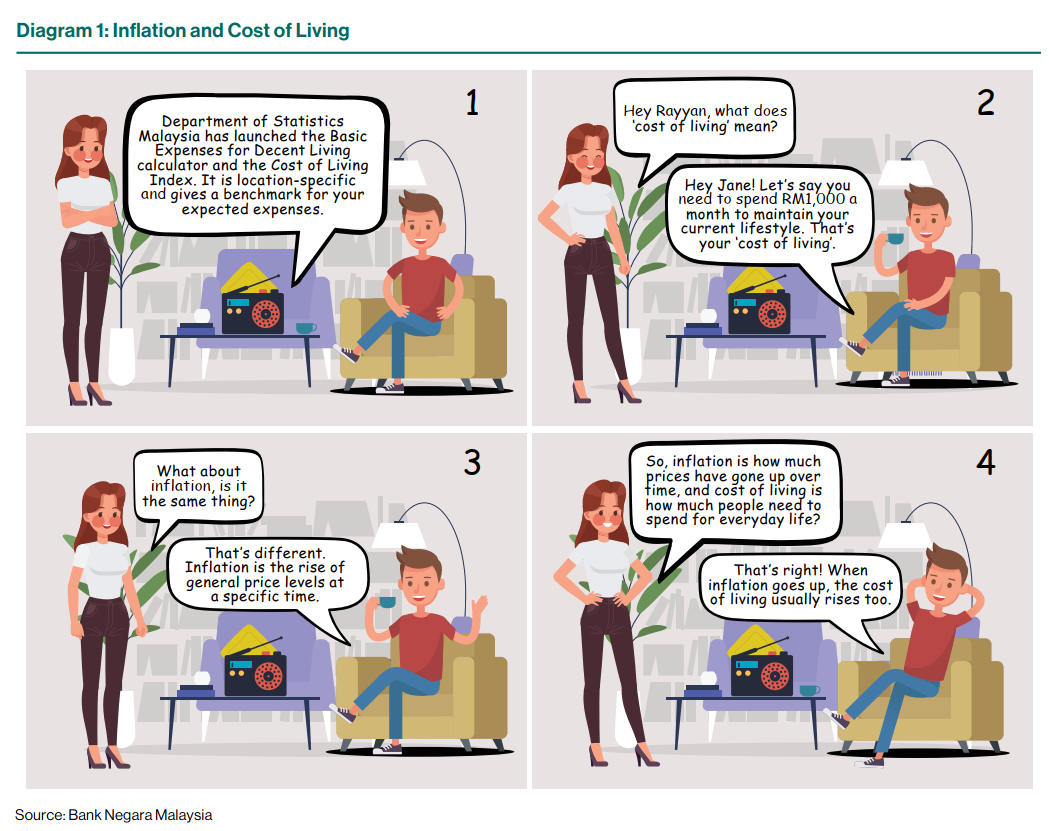
Inflation and cost of living are two important economic concepts that impact the daily lives of individuals and the overall economy. While price levels refer to the overall cost of things you buy at a specific point in time, inflation[1] refers to the rate of change in price levels of a fixed basket of consumption items that represent the average pattern of purchases among Malaysian households. Though it may not necessarily reflect the day-to-day experience of price increases, it is a useful indicator for understanding the changes of overall prices of goods and services in the broader economy. On the other hand, cost of living (COL)[2] refers to the expenditure amount required to maintain a certain standard of living. This varies across households depending on income level, spending behaviour, location and other factors.
Drivers of rising cost of living in Malaysia
Cost of living can be affected by a general increase in price levels, as measured by inflation. In recent years, the resurfacing of concerns over the increasing cost of living was driven by the high inflation environment following the reopening of the economy post-pandemic. Even when inflation has moderated since 2023, the price levels of goods and services have remained elevated.[3] Evidently, this remains in public discourse where concerns on affordability and household expenses are frequently highlighted.
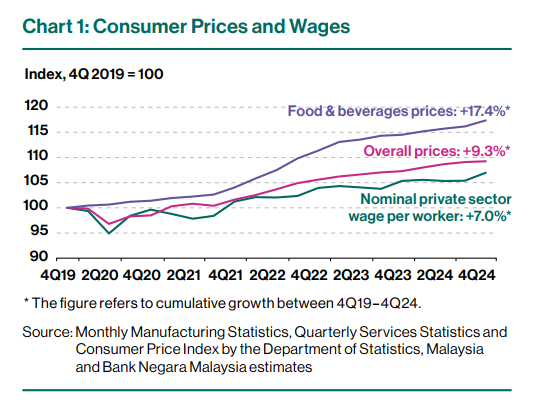
Beyond the increase in expenditure caused by higher prices of goods and services, cost of living also considers the income perspective. Households will feel the pressure from rising cost of living if their income does not increase at the same pace as prices. When this happens, their purchasing power is eroded and their standard of living declines. Since the pandemic, wage growth has not kept up with the rise in overall prices (Chart 1). Lower-income households are more vulnerable, given that they typically have minimal financial buffers. Additionally, they tend to spend a larger proportion of their income on food.[4] The increase in food inflation is particularly concerning as it further erodes their already low purchasing power. Income growth must match or surpass inflation to preserve purchasing power to maintain or improve living standards.
Did You Know?
Malaysia’s long-term average inflation rate has generally been low and stable, typically around 2% per year over the past few decades.
Monetary policy is one of the primary policy tools to manage inflation and contain increases in the cost of living
One aspect of tackling the rise in cost of living is to ensure inflation remains low and stable. Monetary policy is one of the primary tools to manage inflation through its effect on overall demand conditions. At the same time, although managing inflation is a necessary condition for containing increases in the cost of living, it is not sufficient on its own to fully address the issue.
Bank Negara Malaysia (BNM) implements monetary policy by determining the Overnight Policy Rate (OPR). This rate, in turn, affects how banks set their interest rates for loans, financing and deposits. During a period of strong demand and high inflation, BNM raises the OPR which will make it more expensive for banks to borrow money overnight from the central bank and from each other. Banks will subsequently raise loan rates for businesses and consumers. To raise funds, banks will also increase the deposit rates. As a result, borrowing becomes more expensive, while savings become more attractive given the higher returns. These two factors will discourage spending and investment in general, eventually lowering demand in the economy. Economic activity will slow down and dampen the pressure on prices, helping to contain inflation.[5]
As inflation is also driven by factors beyond demand, relying on monetary policy alone is not sufficient to address rising prices. Specifically, monetary policy is not able to tackle challenges arising from supply shocks or changes in regulation that often lead to a higher cost of production and eventually, higher prices to consumers. In addition to that, monetary policy takes effect with a lag. According to BNM’s estimates, it might take up to two years for an interest rate increase to fully affect inflation. The outcome depends on several factors, including how fast banks adjust their deposit and lending rates,[6] to what extent consumers and businesses change their spending and whether demand weakens enough to slow down price increases. This delay means prices might continue rising for a while before stabilising, making it hard to limit increases in households’ cost of living. Therefore, addressing inflation would require other complementary policy tools to influence prices borne by households, especially those affected by supply factors.
What causes inflation?
Demand shocks occur when there is a sharp increase in demand for goods and services in the economy.[7] When the economy is unable to meet the strong demand, it leads to a situation known as ‘too much money chasing too few goods,’ as coined by economist Milton Friedman.[8] Excess demand prompts businesses to raise prices of goods and services, leading to inflation. This was seen after the pandemic when a combination of continued Government policy support[9] and the realisation of pent-up demand led to higher household spending. Demand grew as a result, which contributed to a rise in inflation.[10]
Supply shocks, on the other hand, occur when there is a sudden fall in the supply of goods and services in the economy. This can be caused by factors such as adverse weather conditions, disruptions in supply of input materials and factory closures. As a result, production capacity is affected and costs may increase. For example, export restrictions in key commodity-exporting countries stemming from the Russia–Ukraine military conflict were key factors driving the surge in global energy and food commodity prices in 2022.
Regulatory changes, such as new taxes, tariffs or requirements to comply to stricter environmental policies can increase production costs. Often, businesses pass on the rise in costs to consumers in the form of higher prices. For instance, the increase in the sales and service tax (SST) rate in early 2024 exerted upward price pressures on most taxable services, such as the tax on electricity bills for households with monthly usage exceeding 600kWh.[11]
Fiscal policy can complement monetary policy to manage inflation and cost of living
Besides conducting monetary policy through the central bank, the Government can use fiscal policies to manage inflation as well as cost of living issues. Fiscal policy is the use of government spending and tax policies to influence economic conditions such as demand, growth and inflation. Similar to monetary policy, it acts as a counter-cyclical stabiliser for the economy, smoothing the highs and lows of economic activity. When demand is high, the Government can cut its spending to lower demand and help reduce upward pressure on prices. It can also raise taxes to reduce disposable income, which moderates spending and helps to stabilise price pressures.[12]
Unlike monetary policy, which is a blunt tool, fiscal policy can be more targeted to help reduce living costs for specific groups. For example, the Government can help to manage these rising expenses by providing targeted subsidies or tax breaks to households. Furthermore, when supply disruptions from events such as adverse weather cause general prices to increase, the Government can give cash assistance to affected households to supplement their income. Alternatively, financial assistance or subsidies can be provided to businesses to help them manage the higher production costs from the supply shocks, which could lower the extent of cost pass-through and the eventual price increases to consumers. However, this would increase fiscal burden and limit investments in other critical areas such as health, education and infrastructure. Therefore, this approach should be done judiciously and as a temporary measure as it only addresses the symptoms rather than the root cause of cost of living concerns.
Fiscal policy also plays a role in raising the economy’s productive capacity. The Government can encourage this by, for example, investing in infrastructure, offering favourable tax policies for specific sectors like high-growth-high-value (HGHV) industries and promoting research and development (R&D) initiatives. This makes the economy more competitive and efficient, allowing businesses to expand production at lower costs. Eventually, this can translate to a more moderate pace of inflation.
Price Controls
There are also temporary policy measures to control inflation which target specific sectors or items in the consumption basket. Price controls, such as price ceilings on essential items, can help ease the burden from high cost of living by making goods more affordable for low-income households. While price controls may directly help in the short run, they should not be applied for too long because they distort the determination of prices by market forces. Fixing prices below its actual market levels over an extended period could promote excessive consumption and wasteful behaviour, which can lead to supply constraints.[13] Allowing prices to be set based on demand and supply gives a fair value of how much goods and services are worth, reflecting what buyers are willing to pay compared to what sellers want to charge. Prices can then act as a signal to guide efficient allocation of resources.
Structural reforms address the root causes of price pressures that affect the cost of living
Price pressures could also arise from market structures that increase costs and make the economy more vulnerable to shocks. For example, market inefficiencies could lead to monopolistic practices and reduced competition. This allows large firms to raise prices of goods and services without improving quality. In this regard, structural reforms can be undertaken to boost productivity, enhance competition and strengthen economic resilience. These reforms involve long-term adjustments to policies, institutions and economic frameworks. The ultimate goal is to create a vibrant economic environment that promotes competition, efficiency and higher income growth. At the same time, it seeks to keep inflation low and stable. By tackling both cost and income factors, these reforms help households better handle future cost of living challenges.
Structural reforms can take on many forms. One approach is reducing regulatory burdens which can involve reforming tax and subsidy systems, improving public services and simplifying compliance practices. Such measures would ease business operations and speed up processes, which in turn improves efficiency and reduces costs of doing business.
Promoting technology adoption and encouraging R&D are also key in structural reforms. By offering incentives such as tax breaks and grants, businesses can invest in cutting-edge technologies and innovative methods. As economies focus on technology and R&D, they can make better use of existing resources and attract high-value investments that boost productivity. As more goods are produced with the same or less resources, this enhanced productivity enables businesses to increase wages while keeping prices competitive.
Furthermore, enhancing competition is also crucial for economic efficiency. Lowering trade barriers like tariffs and quotas would reduce barriers of entry for businesses. The promotion of healthy competition and prevention of anti-competitive practices help keep prices competitive and drives innovation. For consumers, this translates to more affordable goods and services of better quality.
Policies should also be focused on meaningfully increasing incomes, allowing households to afford goods and services amid rising prices
Another aspect of tackling cost of living pressures is to raise income. Implementing strategic and innovation-driven industrial policies, as well as labour market reforms can increase household income through improvement in productivity, creation of more job opportunities and fair compensation. There are several strategies to achieve this.[14] For example, initiatives have been directed at promoting creation of high-skilled jobs.[15] On the labour supply side, education and training programmes can also be enhanced to upskill the workforce so that they can take on more complex roles and high value work which pay higher salaries. In the longer-term, reforms to the education system that encourage more students to pursue science, technology, engineering, and mathematics (STEM) fields would also help meet the labour demand of a high value-added economy.
Following that, reforms can focus on improving labour market flexibility by easing restrictive labour laws and encouraging workforce mobility. For example, improving skills standardisation would enable movement of workers between different jobs and industries. By leveraging technology, work arrangements can also be made flexible to accommodate diverse workforce needs and boost labour participation, especially for women.[16]
Next, it is also essential to strengthen labour market institutions and implement policies that promote fair compensation, in line with worker productivity. This includes enhancing existing wage policies such as the minimum wage law and the Productivity-Linked Wage System. Additionally, more transparent and fair wage-setting practices can be encouraged through collective wage bargaining and negotiations, to improve earning capacity of workers.
Lastly, the social protection system[17] is fundamental for providing a safety net for vulnerable groups impacted by economic shocks. Temporary financial help can be provided through direct cash transfers to reduce financial stress. The social insurance program is also critical to ensure ongoing income support as costs of living rise. Given that vulnerable populations tend to work in the informal sector,[18] they can be protected through provision of legal rights, social security benefits and workplace safety.
For the social protection system to be effective in helping people navigate cost of living challenges, it needs to be inclusive and easy to access. Accurate data on households is necessary to effectively target and distribute benefits. Moreover, people should have access to various services for different life-cycle risks which include income support, as well as health, education, housing and unemployment benefits. To avoid over-reliance on these benefits, it is important to keep an eye on how people’s financial situations improve. Then, assistance can be gradually redirected to others who need it more.
Households can also improve their financial situation by learning how to manage their money more effectively and make better spending choices. Platforms such as the Financial Education Network (FEN) [19]drive efforts to promote financial literacy which can help people manage their spending and debt. [20]Additionally, if households need assistance in managing their finances, they can get help from agencies like the Credit Counselling and Debt Management Agency (Agensi Kaunseling dan Pengurusan Kredit, AKPK). AKPK offers services such as financial education, counselling, and advice on financial management, along with debt management programmes to help people move towards financial freedom.
Conclusion
The cost of living is a fundamental aspect in people’s daily lives and is a crucial determinant of their overall well-being. As such, it remains a key policy priority for any government in shaping decisions targeted at improving the standard of living. More direct measures, like price controls and subsidies, can be very impactful at providing short-term financial relief and keeping the prices of essential goods stable. However, they must be used sparingly as they tend to be fiscally expensive and not sustainable. Furthermore, they may lead to distortions that prevent natural price adjustments, which could negatively affect the economy in the long-term. In this vein, countercyclical macroeconomic policies such as monetary and fiscal policy along with structural reforms must work together in keeping inflation low and stable. Achieving price stability is also a prerequisite for creating the favourable conditions necessary for further structural reforms to take root and flourish, and most importantly, raise household income. These measures will take time before they result in a more enduring and impactful reduction in the cost of living.
Ultimately, addressing these issues requires strategic planning with a careful balance between short-term and long-term goals. It involves continuous dialogue with key stakeholders and clear communication to build public understanding and support for the benefits of these reforms. By aligning monetary and fiscal policies with structural reforms, policymakers can create a cohesive framework that keeps inflation low and stable, and ensures the cost of living remains manageable.
Notes
[1] Inflation is measured by the Consumer Price Index (CPI), which is published by Department of Statistics Malaysia (DOSM) monthly. For further information, please refer to the white box ‘Inflation, the Cost of Living and the Living Wage’ in the BNM Annual Report 2018.
[2] Cost of living can be measured by the Basic Expenditure of Decent Living (PAKW), which was first published by DOSM in December 2024.
[3] Post-pandemic, the inflation rate in Malaysia moderated significantly to 1.7 % in January 2025 from a high of 4.7% in August 2022.
[4] Based on the 2022 Household Expenditure Survey by DOSM, B20 households spend 31.1% of their monthly income on food and beverages, whereas T20 households spend 16.6% of their monthly income on the same category.
[5] On the reverse, when inflation is too low, BNM lowers the OPR, which will lead to lower borrowing cost and deposit rates. This will encourage businesses and households to spend, thereby raising demand and eventually exerting upward pressure on inflation. Inflation that is too low often signals weak demand in the economy, which occurs when consumers and businesses are not spending or investing enough.
[6] This could be caused by rapid income growth from strong economic activity, very low interest rate causing excessive borrowing, too much spending by the Government that increases people’s disposable incomes and improved consumer sentiments about the economy.
[7] Excess money is created when central banks lower interest rates, making borrowing cheaper and increasing the money supply and when government spending through deficit financing injects additional funds into the economy.
[8] Government stimulus measures included cash transfers, subsidies on select consumer items and seasonal price controls.
[9] Inflation surged following the pandemic, driven by both increasing demand and supply shocks. For further details, please refer to the box article ‘An Anatomy of Inflation: Effects from the Prolonged Pandemic’ in Bank Negara Malaysia’s Economic and Monetary Review 2021.
[10] Effective from 1 March 2024, the service tax rate increased from 6% to 8% for all taxable services excluding food and beverage services, telecommunication services, parking services and logistics services.
[11] This adjustment is particularly relevant for new loans, as changes to existing loans are transmitted immediately.
[12] On the flip side, during economic downturns, governments can increase spending to boost demand and stimulate economic activity. They can also lower taxes to raise disposable income, encouraging greater consumer spending and investment. These measures help to raise economic growth and lessen pressure on firms to reduce prices. While lower prices can be beneficial for consumers, it may also lead to workers earning lower wages and businesses making smaller profits.
[13] For further details, please refer to the box article ‘Price Reforms: Motivation, Impact and Mitigating Measures’ in Bank Negara Malaysia’s Annual Report 2014 and the box article ‘Cost of Living Revisited: Causes and Consequences’ in Bank Negara Malaysia’s Annual Report 2021.
[14] For further details, please refer to the box article ‘The Case of Labour Reforms in Malaysia: Challenges and Opportunities’ in Bank Negara Malaysia’s Economic and Monetary Report 2023.
[15] The National Investment Aspirations (NIA) is expected to create approximately 500,000 high-skilled jobs over the next five years. Additionally, the New Industrial Master Plan 2030 (NIMP 2030) targets the creation of 3.3 million job opportunities by 2030, including positions in high-value sectors such as advanced manufacturing, technology, and services.
[16] As at fourth quarter of 2024, the female labour force participation rate (LPFR) was 56.8%, significantly lower than men at 83.6%.
[17] The social protection system includes social safety nets, employment insurance and active labour market policies.
[18] The informal sector refers to economic activities that are not regulated by the government and typically operate outside formal legal and tax frameworks. Examples include street vendors selling goods, domestic workers providing household services and artisans creating handmade products.
[19] The Financial Education Network (FEN) is an inter-agency platform committed to improving the financial literacy of Malaysians. For more information, please refer to: www.fenetwork.my.
[20] Based on the 2024 Financial Capability and Inclusion Demand Side Survey (FCI), the Malaysian Financial Literacy Index (MYFLIC) revealed an optimistic picture for financial knowledge. Between 2018 and 2024, the financial knowledge component of the index increased by 7.3pts from 55.6 to 62.9.
CSS
